When It Goes Wrong
A crust like armour comes from the last third of the bake
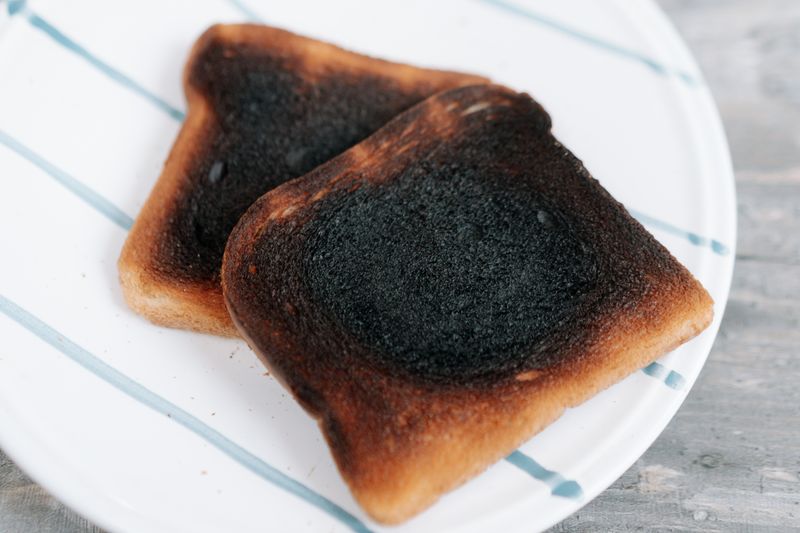
Thick, hard crusts are usually blamed on the oven being too hot, and the more common cause is a long bake in dry air after the loaf had finished rising.
The options around thick or tough crusts are set out side by side below, with the conditions that genuinely favour one over the other.
The difference in one place
- Crust thickness grows as the drying front moves inward.
- Dry oven air late in the bake accelerates it.
- Cooling and storage decide how hard the crust ends up.
How a crust gets thicker
The crust is the region where the dough has dried enough for its temperature to rise past boiling. That drying front moves inward as the bake continues, so a longer bake means a deeper crust. Thickness is therefore a function of time in dry heat rather than of temperature alone.
A short bake at high heat gives a thin, crisp crust, while a long bake at moderate heat gives a thick one. This is why extending a bake to be sure the middle is done thickens the crust as a side effect.
The role of oven humidity
Steam early in the bake keeps the surface moist, delaying crust formation and allowing the loaf to expand. Once the steam clears, the surface dries and the crust begins forming in earnest.
An oven that vents aggressively, or a fan running throughout, dries the surface faster and thickens the crust. Baking in a covered pot for the first part and uncovered for the rest gives you control over that balance. A loaf baked entirely uncovered in a dry fan oven has the thickest crust available from a given recipe.
Recipe factors
Lean doughs of flour, water, salt and yeast produce the hardest crusts, since nothing softens them. Fat, milk and sugar all soften a crust, which is why enriched breads have a completely different surface. A very low hydration dough has less water to lose and dries through more quickly, giving a thicker crust.
Once the crumb sets, wholemeal loaves tend towards thicker crusts because bran holds water differently and dries unevenly. None of these are faults in themselves, and the question is only whether the result is what you wanted.
Baking to a finish rather than a time
Taking the internal temperature tells you when the loaf is done and prevents the defensive extra ten minutes. That defensive extra time is precisely the period during which the crust thickens most and the crumb dries fastest. Loaves baked past their finish also lose crumb moisture, so a thick crust often comes with a dry interior.
Reducing the oven temperature for the last part of the bake finishes the middle with less crust growth.
Removing the loaf from its tin for the last part of the bake sets the sides without thickening the top.
What cooling does
A crust straight from the oven is crisp because it is dry and hot, and it changes as moisture redistributes. Cooling on a rack allows steam to escape from underneath rather than condensing against the base.
As the loaf cools, moisture migrates from crumb to crust, which softens a thin crust and leathers a thick one. That is why the crust you have an hour after baking is not the crust you had at the oven door. Judging crust quality immediately is misleading, and the honest assessment comes once the loaf is cold.
Storing for the crust you want
Wrapping a crusty loaf in plastic while it is still fresh softens the crust completely within a few hours. A paper bag or a cloth keeps a crust crisper while letting the crumb dry faster. A bread bin sits between those two extremes, holding some humidity around the loaf without sealing it in completely.
The dough tells you first: refreshing a stale crusty loaf briefly in a hot oven restores much of the original crispness. You cannot have a crisp crust and a soft crumb indefinitely, and every storage choice trades one for the other.
Side by side
| Consideration | What it means in practice |
|---|---|
| How a crust gets thicker | Crust thickness grows as the drying front moves inward. |
| The role of oven humidity | Dry oven air late in the bake accelerates it. |
| Recipe factors | Cooling and storage decide how hard the crust ends up. |
The takeaway
Bake to a finish rather than to a safety margin, since the crust grows during every extra minute.
Temperature and time are the same argument held at opposite ends.
Questions readers ask
Is a thick crust a sign of a bad loaf?
Not at all, since many traditional breads are prized for exactly that. It is only a fault if you wanted something thinner and the bake produced otherwise.
Why is my crust hard rather than crisp?
Hardness usually means a thick crust that has taken on moisture from the crumb and gone leathery. A shorter bake and a thinner crust will be crisp rather than hard.