When It Goes Wrong
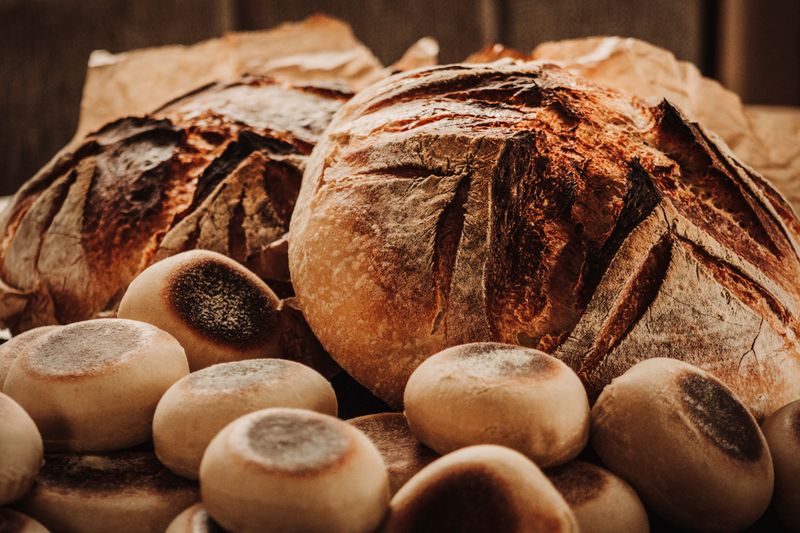
Your loaf burst at the side because the crust set before it finished rising
A tear along the base or the shoulder rather than an opening at the score is one of the most legible faults in bread, and it points at two or three things only.
Most explanations of loaves bursting at the side stop at the point where it starts to matter. This one carries on.
The short version
- A shallow score sends the expansion elsewhere.
- A dry oven sets the crust within four or five minutes.
- An open seam is the weakest point and will tear first.
What the burst tells you
A loaf bursting at the side has more expansion available than the crust could accommodate, which is actually a good sign about the dough. It means fermentation, shaping and gluten development were adequate, since an overproved or weak loaf would simply spread instead. The problem is that the surface set into a rigid shell before the expansion finished, so the pressure found the weakest point.
That weakest point is usually the seam, the base where the loaf meets the tray, or wherever the surface dried first. So this is a baking fault rather than a dough fault, which makes it comparatively easy to fix.
Score depth
Most home scores are far too shallow, barely breaking the surface, so they never become the release point they were meant to be. A cut of five to ten millimetres on a standard loaf is decisive enough to control where the loaf opens. Speed matters more than pressure, because a fast pass parts the dough before surface tension can drag the blade sideways.
In the tin, a hesitant, sawing cut leaves a ragged shallow line that neither opens cleanly nor relieves the pressure. If the score is barely visible after baking and the side has torn, depth is almost certainly the issue.
Insufficient steam
A dry oven dries the loaf surface within four or five minutes, and dried dough stiffens into a shell that cannot stretch further. Steam keeps the surface moist and flexible for the first ten to fifteen minutes, which is when almost all expansion happens.
At oven temperature, a lidded cast iron pot traps the loaf's own moisture and is the most reliable home solution by a wide margin. A preheated cast iron tray on the oven floor with a cup of boiling water poured onto it produces a useful burst for a few minutes. Spraying the oven walls achieves very little, since a fine mist has almost no thermal mass and vents immediately.
An open seam
The seam left by shaping is the weakest part of the surface skin, and an unsealed one is an open invitation for the loaf to burst there. Pinch it closed firmly and place it seam up in a banneton or seam down on the tray so the loaf's own weight helps seal it.
In the tin, a loaf that tears exactly along a straight line on one side is almost always showing you where the seam was. Over-tightening during shaping can tear the skin, which creates the same weakness from the opposite direction.
Small surface tears during shaping are a signal to stop rotating, not to add another turn.
Oven temperature and position
An oven that is too hot sets the crust faster and narrows the expansion window, particularly with the top element running. Starting at 230 to 250C with steam and dropping to 210 to 220C once the steam phase ends suits most lean loaves. A loaf too close to the top element browns and sets on the upper surface long before the sides have finished.
Weighed out, baking on a preheated stone or steel gives strong base heat, which drives expansion upward rather than sideways. If the burst is consistently at the base, the base heat may be excessive rather than insufficient.
Proving times are written for a warm kitchen, and yours may not be one.
Reading the result next time
A clean opening at the score with a raised lip means tension, proving and steam all worked together correctly. A score that barely opened despite good volume suggests the dough was slightly overproved and had little expansion left. A burst with a pale, matte crust points at a dry oven; a burst with a very dark crust points at excessive heat.
Weighed out, photograph each loaf and note the steam method, since the pattern becomes obvious across four or five bakes. This fault is one of the fastest to eliminate once you start treating the crust as a separate variable from the dough.
The takeaway
Score deeper, add steam, and seal the seam, then watch where the loaf chooses to open.
Bake it badly once on purpose. The failure teaches more than the photograph.
Questions readers ask
Should I score deeper or add more cuts?
Start by scoring deeper with a single decisive cut, since multiple shallow cuts distribute the pressure and reduce the dramatic opening. More cuts generally means less height at any one point.
Does this happen with tin loaves too?
It shows up differently, usually as a mushroom top that tears at the shoulders where the dough overhangs the tin. The cause is the same, which is a crust setting before the expansion finished, often combined with an overfilled tin.