Baking Science
Egg proteins set between about 62 and 82C, and that governs everything
Yolk and white coagulate at different temperatures, which is why custard curdles, meringue sets and cake crumb holds together at all.

This is less a set of instructions about egg protein coagulation than an argument, and it is worth saying so at the start.
The argument in brief
- Egg white begins setting around 62C, yolk nearer 65 to 70C.
- Sugar and dilution raise the setting temperature.
- Past the setting point, proteins squeeze out water and curdle.
What coagulation is
Egg proteins are folded molecules that unfold when heated, then bond with each other into a three-dimensional network. That network traps water, which is why a set custard is firm rather than liquid despite being mostly water.
Push the heat further and the bonds tighten, squeezing water out and leaving curds in a watery liquid. So the difference between a silky custard and scrambled eggs is a few degrees in one direction. This is why so many egg preparations specify temperatures rather than times.
White and yolk differ
Egg white begins to set somewhere around 62C and is firm by about 65C, though different white proteins set across a range. Yolk sets a little higher, roughly 65 to 70C, which is what makes a soft-boiled egg possible at all. A whole egg mixture therefore sets across a range rather than at a single point.
In baking this matters most in custards, curds and anything where egg is the sole setting agent. These figures are for plain egg and shift as soon as anything else is added.
Sugar and dilution raise the point
Adding sugar raises the temperature at which egg sets, sometimes by several degrees, by interfering with protein bonding. Diluting with milk or cream does the same, which is why a baked custard tolerates a higher oven than plain egg would. A crème anglaise with plenty of sugar can be taken to around 82 to 84C without curdling, where plain egg would have set long before.
At oven temperature, this is also why a sweetened lemon curd is more forgiving than an unsweetened one. Salt and acid work in the opposite direction, lowering the setting temperature slightly.
Custards and gentle heat
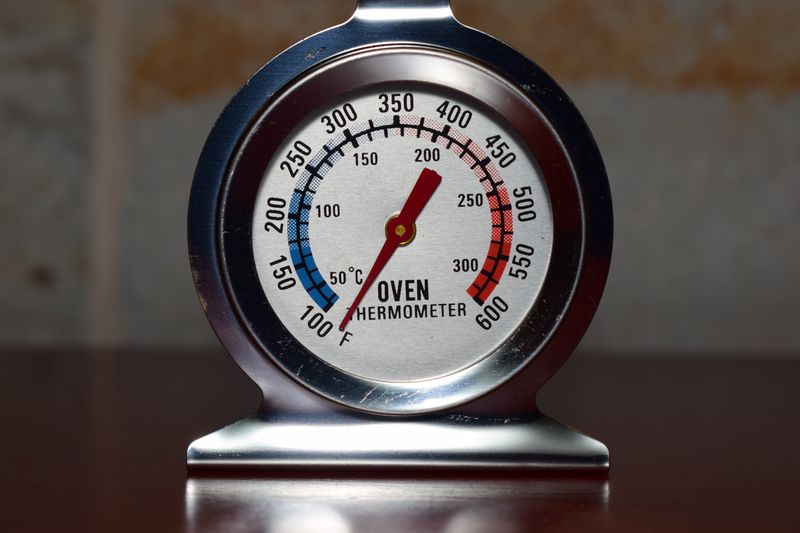
Stirred custards are cooked to a specific temperature, usually 80 to 84C, and removed immediately. Baked custards go into a low oven, often 150C or less, and are frequently protected by a water bath. The water bath holds the outside of the dish near 100C at most, preventing the edges setting far ahead of the centre.
Weighed out, a custard removed while it still wobbles in the middle will set fully from residual heat as it cools.
Waiting for the centre to look firm in the oven almost always means it is already overcooked.
Egg in cakes and breads
In a cake, egg protein sets alongside starch gelatinisation and contributes a substantial part of the structure. Because egg sets lower than starch gelatinises fully, it is often the first structural component to firm.
That is why an egg-rich cake feels set at the edges before the centre has finished at all. In enriched bread, egg white adds structure that partly offsets the weakening effect of butter. Yolk contributes lecithin, an emulsifier, and fat, both of which soften rather than strengthen.
Weigh rather than scoop wherever a recipe leaves you the choice.
Rescuing overcooked egg
A custard that has just started to curdle can sometimes be saved by blending immediately and passing through a sieve. Adding a spoonful of cold cream stops the temperature rising and buys a few seconds. Once the curds are large and the liquid is clearly separated, the emulsion is beyond recovery.
A pinch of cornflour in the mix raises the safe temperature considerably and is standard in pastry cream. The starch interferes with protein bonding, which is why pastry cream can be boiled where custard cannot.
The takeaway
Learn the two setting ranges, use a thermometer, and pull custards while they still look underdone.
Patience is an ingredient, and it is the one people leave out.
Questions readers ask
Why does my baked cheesecake crack?
The egg proteins were taken too far and contracted, pulling the surface apart. A lower oven, a water bath and removing it while the centre still wobbles all reduce the risk.
Can I use a thermometer for custard instead of the spoon test?
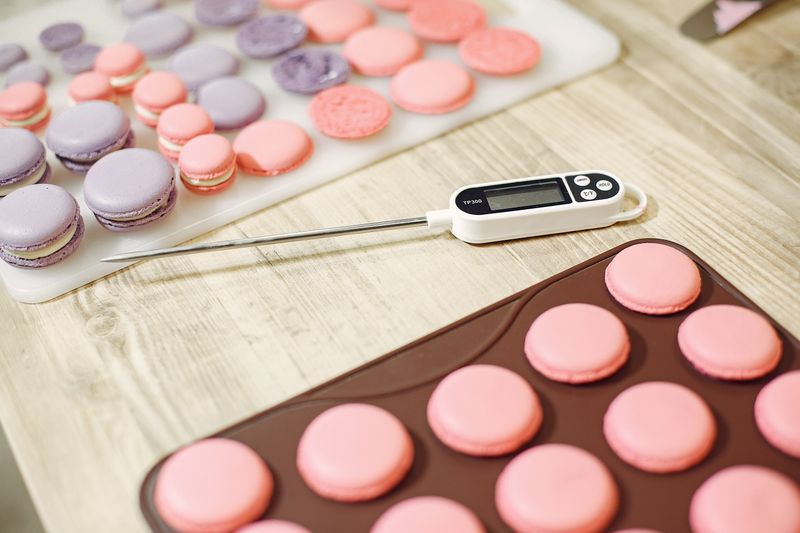
Yes, and it is considerably more reliable. Aim for around 80 to 84C for a stirred custard, stirring constantly and removing from the heat the moment you reach it.