Baking Science
Altitude changes every leavened recipe, and pressure is the reason
Lower air pressure means gas expands more freely and water boils cooler. Both effects work against a rising batter at the same time.

This is less a set of instructions about baking at altitude than an argument, and it is worth saying so at the start.
The argument in brief
- Water boils around 95C at 1500m and lower still higher up.
- Gases expand more at lower pressure, so bubbles over-inflate.
- Reduce raising agent, increase liquid, and raise the oven temperature slightly.
What changes physically
Atmospheric pressure falls with altitude, so the gas inside a batter meets less resistance and expands further for the same heat. Water also boils at a lower temperature, roughly 95C at 1500 metres and lower again as you climb. Evaporation therefore happens faster and earlier in the bake, drying out batters and doughs that would have stayed moist at sea level.
Structures that would normally set once the interior approached 100C now have to set at a lower temperature, which shortens the window available for expansion. The combination of both effects is why recipes developed at sea level frequently misbehave above roughly a thousand metres of elevation.
Cakes suffer most
A cake batter at altitude over-inflates because each bubble expands further against the reduced surrounding pressure than it would lower down. The structure then cannot hold what it has made, and the classic symptom is a cake that rises magnificently and sinks into a crater in the middle. Reducing the chemical raising agent, often by a quarter to a half depending on how high you are, limits that over-expansion directly.
Increasing the flour slightly and reducing the sugar strengthens the structure so it sets before the bubbles have grown past what it can support. Adding an extra egg is another common correction, since egg protein contributes structure without generating any additional gas.
Liquid and drying
Faster evaporation at lower pressure means batters and doughs lose water during baking, giving a dry, crumbly result from an unchanged recipe. Adding one to three tablespoons of extra liquid to a standard cake is a common starting adjustment, scaled up as elevation increases. Covering loaves and cakes part way through the bake reduces surface evaporation without altering the recipe at all.
Storage matters more as well, since baked goods that started drier will reach an unpleasantly stale state noticeably sooner. All of these corrections scale with elevation rather than being a single fix that works everywhere above sea level.
Bread at altitude
Bread doughs ferment faster at altitude because the gas produced expands more readily against the lower pressure holding it in. Reducing the yeast quantity, mixing with cooler water or moving the dough into a fridge retard all restore control over the timing. Doughs also dry out faster during bulk fermentation, so covering them properly matters considerably more than it does at sea level.
Once the crumb sets, a slightly higher hydration compensates for the increased evaporation during both proving and the bake itself.
Sourdough is often easier to manage at altitude than commercial yeast, because it ferments slowly enough to stay within a controllable window.
Oven temperature
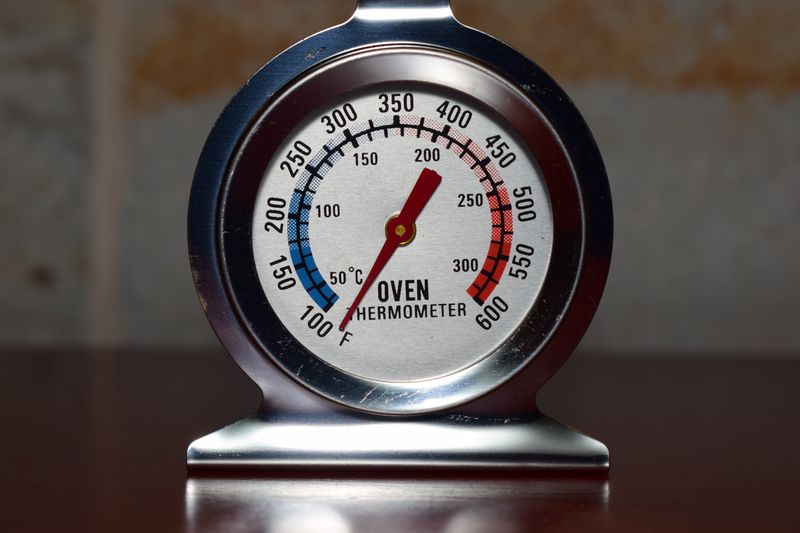
Raising the oven by roughly ten to fifteen degrees is the usual recommendation, because it sets the structure sooner in the bake. That earlier set catches the batter before the bubbles have over-expanded and the whole structure has collapsed inward.
The total bake time usually shortens slightly as a consequence, so start checking several minutes before the recipe suggests. The higher temperature also drives surface browning faster, so watch the colour and be ready to cover with foil. This adjustment interacts with all the others, which is why altitude baking needs testing in your own kitchen rather than a single formula.
Flour absorbs water differently by brand and by season; hydration is a target, not a rule.
Working it out for your kitchen
Published adjustment tables are useful starting points, but the corrections vary considerably between recipe types and between individual formulas. Change one variable at a time and write down the elevation, the specific adjustment and what the result actually looked like. Cakes, breads and pastries each need different corrections, so a single rule of thumb will not serve all three reliably.
Local bakers and locally published recipe collections are often the best available source of practical numbers for a given elevation. Below about nine hundred metres most recipes work unchanged, so this is genuinely a high-elevation problem rather than a general one.
The takeaway
Less raising agent, a little more liquid and a slightly hotter oven, then test and write it down.
Bake it badly once on purpose. The failure teaches more than the photograph.
Questions readers ask
Does altitude affect pastry as much as cake?
Much less, since pastry relies on steam and fat rather than on chemical leavening holding a delicate structure. The main effect is faster drying, which can be countered with a slightly wetter dough.
Is there one adjustment that helps most?
Reducing the chemical raising agent is usually the single most effective change for cakes. It directly addresses the over-expansion that causes the collapse.
Also by Gaurav Bhattacharya
- Baker's percentages let you rescale, compare and diagnose any recipeBaking Science
- Amylase, falling number and why bakers add malt to flourBaking Science
- A set of one gram scales is the cheapest upgrade in the kitchenTins & Tools
- Your oven dial is a suggestion and a cheap thermometer proves itTins & Tools