Pastry
Six turns gives 729 layers, and the seventh makes things worse
Layer counts in laminated pastry are simple arithmetic with a hard ceiling. Past a certain thinness the sheets merge and the lift starts to fall.

There is a settled way of talking about layer counts in laminated dough. It is worth asking how much of it survives contact with the detail.
The argument in brief
- A letter fold multiplies layers by three; a book fold by four.
- Six letter folds give 729 dough layers.
- Below roughly a hundredth of a millimetre, butter sheets break up.
The arithmetic
Each single or letter fold takes the current stack, folds it in three, and therefore triples the number of layers. Starting from one, six letter folds give three, nine, twenty seven, eighty one, two hundred and forty three, then seven hundred and twenty nine. A book or double fold folds both ends to the middle and then in half, multiplying by four each time.
Recipes mix the two to reach a target quickly, so four book folds gives two hundred and fifty six layers in fewer sessions. The numbers are exact but the physical reality is messier, since every tear reduces the effective count.
Why more is not better
As the layer count rises, each sheet of butter gets proportionally thinner while the total butter stays the same. Below a certain thickness the butter can no longer form a continuous film and breaks into discontinuous patches.
Where that happens, adjacent dough layers touch and fuse, and two layers become one before the oven even starts. Traditional practice stopping at six turns reflects this ceiling rather than an arbitrary tradition. Bakers who have tried eight or nine turns generally report less rise, not more.
Croissants use fewer on purpose
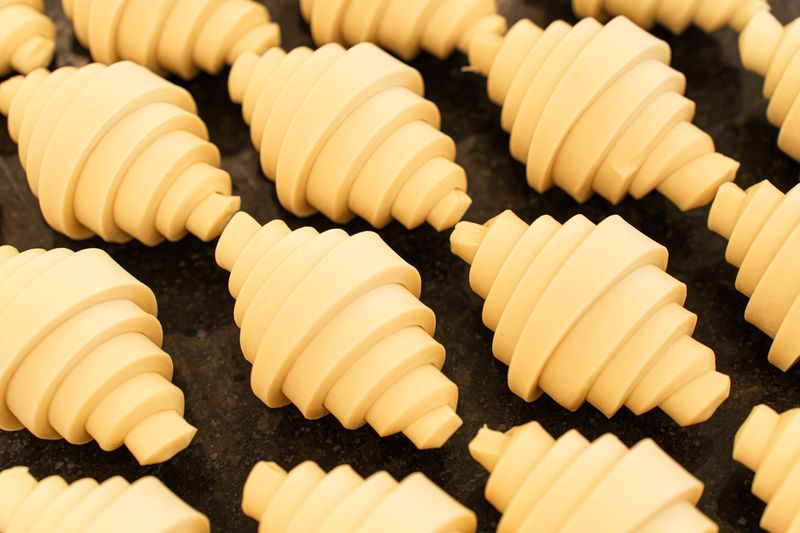
A croissant dough is yeasted, so some of the lift comes from fermentation rather than steam alone. Three letter folds giving twenty seven layers is the common choice, producing thick sheets with a visible honeycomb.
Push a croissant dough to six turns and the interior becomes fine, uniform and bready rather than open. Danish pastry sits in similar territory, often with three or four folds depending on the finished texture wanted. The right number depends on what is doing the lifting, which is why puff and croissant differ so much.
Rolling thickness matters as much
The final rolled thickness determines how thin each individual layer actually is, independent of the count. Rolling a 729-layer block to three millimetres gives very different results from rolling it to eight. For a vol-au-vent you want a thicker final sheet so there is enough material to rise dramatically.
By the second rise, for a millefeuille you want it thinner and often weighted during baking to control the rise deliberately.
Thickness and layer count are two separate dials that people frequently confuse.
Keeping count
It is genuinely easy to lose track, particularly across a session split over several hours with fridge rests. Pressing fingertip dents into the corner of the dough after each turn is the standard bakery solution.
Writing the time and turn number on the wrapping film works just as well at home. An extra turn by mistake is not a disaster, but a missing one shows clearly in the finished pastry. Consistency matters more than the exact number, because it is what makes results repeatable.
Edges and effective count
The folded edges of a laminated block have fewer effective layers than the middle, since the sheets wrap around. This is why puff pastry offcuts from the edges rise less evenly than pieces cut from the centre. Trimming the edges before cutting shapes gives a more uniform rise, and the trimmings still make excellent cheese straws.
Cutting with a sharp downward press rather than dragging keeps the layers open at the cut face. A blunt knife seals the edges together and the pastry rises only in the middle.
The takeaway
Six turns is a ceiling rather than a target, and the final rolled thickness matters just as much.
Temperature and time are the same argument held at opposite ends.
Questions readers ask
Does the starting number of butter layers matter?
Yes, in the sense that the lock-in gives you one butter layer between two dough layers before you begin. Every calculation counts from that starting arrangement, which is why layer counts differ between sources by a factor of one.
Is a book fold better than a letter fold?
Neither is better; a book fold simply gets you to a given count in fewer rolls, which means less total handling. Letter folds give you finer control over the final number.