Pastry
Rough puff, full puff and blitz pastry: what you trade for the time
All three make layers. They differ in how the butter is distributed at the start, and that decides how even the lift is and how much work it takes.
What follows is the working version of the three puff pastry methods: the decisions in the order you actually meet them, with the reasoning attached.
Before you start
- Full puff locks in a single butter block for the most even layers.
- Rough puff distributes butter chunks and gives an irregular rise.
- Blitz pastry is the fastest and the least consistent.
Full puff and the butter block
Classic puff pastry encloses a single flat slab of butter inside a dough envelope, then rolls and folds them together. Because the butter starts as one continuous sheet, every fold divides it evenly and the layers stay uniform across the whole piece. That uniformity is what produces the straight, dramatic vertical rise of a proper vol-au-vent or millefeuille.
It also requires the most control, since the single block must not break, tear or warm at any stage. Expect six turns with chilling between each, spread over three or four hours including rests.
Rough puff
Rough puff starts with butter cut into cubes and rubbed only partly into the flour, leaving visible pieces of perhaps a centimetre. Adding water and rolling flattens those pieces into irregular sheets that still separate in the oven. The rise is uneven and slightly wild, which suits a sausage roll or a tart border but not a neat layered dessert.
Once the crumb sets, it takes four or five turns rather than six, and around half the total time of full puff. For most home uses the difference in the finished dish is smaller than the difference in effort.
Blitz pastry
Blitz pastry pushes the shortcut further, mixing large flakes of butter into flour and water and rolling almost immediately. It is often made in a food processor with very short pulses, which is where the name comes from.
In the tin, the result rises perhaps two thirds as high as full puff, with a shorter, flakier, less layered texture. It is entirely adequate under a pie filling or as a base for something with a strong topping. Where the pastry itself is the point, the shortcut is visible on the plate.
Turns and layer counts
Each single or letter fold multiplies the number of layers by three, so six turns gives 729 dough layers. A book or double fold multiplies by four, so recipes mix the two to reach a target with fewer rolls. Beyond around 700 layers the sheets become thin enough that they start to merge, and additional turns reduce the lift.
This is why traditional recipes stop at six turns rather than continuing indefinitely.
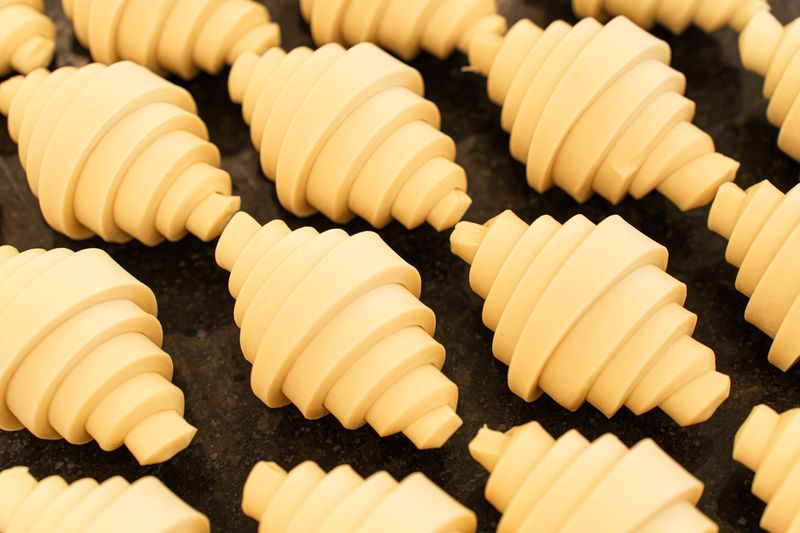
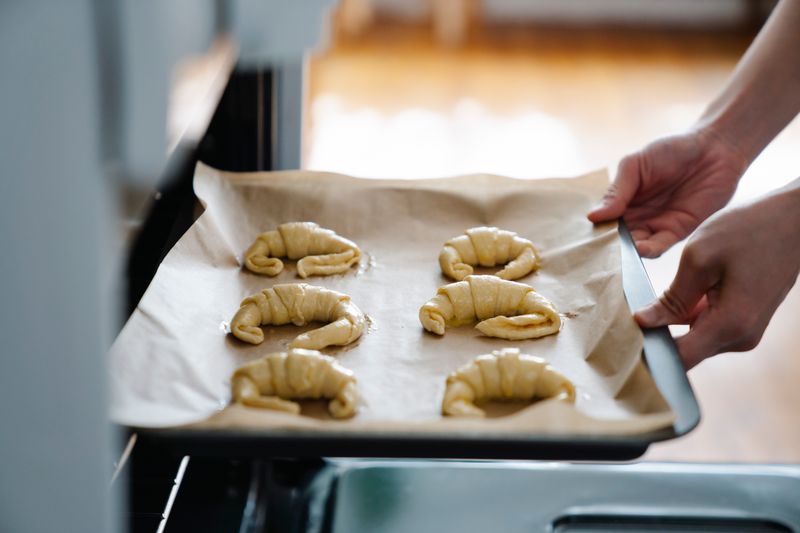
Croissants use fewer turns, typically three letter folds for 27 layers, because a yeasted dough needs thicker sheets.
Resting between turns
Rolling stretches gluten, and a stretched dough fights back, shrinking and tearing on the next pass. Thirty to sixty minutes in the fridge relaxes the gluten and firms the butter at the same time. Skipping rests is the most common reason a home-made puff comes out tough and shrinks badly in the oven.
By the second rise, mark the number of turns completed by pressing fingertips into the dough, since it is remarkably easy to lose count. A final rest of at least an hour before shaping prevents the cut pieces from contracting on the tray.
Weigh rather than scoop wherever a recipe leaves you the choice.
Choosing between them
If you are making a pie lid or a cheese straw, rough puff is a sensible use of your afternoon. If you are making a mille-feuille where the layers are the entire dish, make full puff or buy a good all-butter sheet. Blitz is for when you need something in an hour and the pastry is a vehicle rather than a feature.
Commercial all-butter puff is genuinely good and made with equipment no home kitchen has. There is no shame in reserving your lamination effort for croissants, where the difference is much larger.
The takeaway
Pick the method to match how visible the pastry will be, and rest it properly whichever you choose.
Temperature and time are the same argument held at opposite ends.
Questions readers ask
Why does my puff pastry shrink when I bake it?
The gluten was still tense when it went into the oven. Rest the shaped pastry in the fridge for thirty minutes after cutting, and cut with a sharp downward press rather than dragging a knife.
Can I freeze puff pastry part way through the turns?
Yes, and it works well after the third or fourth turn. Wrap tightly, and thaw in the fridge overnight so the butter and dough come back to the same firmness together.
Also by Sabyasachi Roy
- Creaming butter and sugar is aeration, and the sugar crystals do the cuttingCakes & Sponges
- Reverse creaming gives a tighter crumb, and here is why it worksCakes & Sponges
- A genoise has no baking powder, so what is lifting itCakes & Sponges
- Baking powder and bicarbonate of soda are not interchangeableCakes & Sponges