Pastry
Lamination lives in a temperature window about three degrees wide
Butter has to be firm enough to stay in a sheet and soft enough to stretch with the dough. Outside roughly 15 to 18C, one of those two fails.
There is a short answer about butter temperature during lamination and a useful one, and they are not the same. What follows is the useful one.
The short version
- Aim to keep dough and butter both around 15 to 18C while rolling.
- Butter that shatters was too cold; butter that smears was too warm.
- Rest in the fridge between turns, not the freezer.
What lamination is physically doing
Laminated pastry is alternating sheets of dough and butter, each butter layer perhaps a tenth of a millimetre thick after several turns. In the oven the water in the dough turns to steam and pushes the layers apart while the butter fat melts and fries them. For that to work, the butter must remain as continuous sheets rather than being absorbed into the dough.
Any point where butter has merged into the dough is a place where two layers become one and the lift is lost. Everything about the technique exists to keep those sheets intact through repeated rolling.
Why the window is narrow
Below about 14C, butter is brittle and cracks into shards when rolled, leaving gaps and holes in the sheet. Above about 20C, the fat crystals soften and the butter smears into the dough instead of sliding with it.
In the tin, between roughly 15 and 18C butter is plastic, meaning it deforms and stretches without breaking or melting. The dough needs to be at a similar firmness, since a soft dough with firm butter tears and a firm dough with soft butter absorbs it. Matching the two is more important than hitting an exact number for either.
Managing your kitchen
A domestic kitchen at 22C is already above the window, and rolling generates friction heat on top of that. Work quickly, in short sessions, and return the dough to the fridge the moment it starts to feel soft or sticky. Chilling for thirty to forty minutes between turns is typical, and it also relaxes the gluten you have just stretched.
The freezer firms the outside faster than the centre, giving you a hard shell over soft butter, which rolls badly. In a hot kitchen, chilling the rolling pin and working on a cold surface such as stone or steel both help.
Butter choice
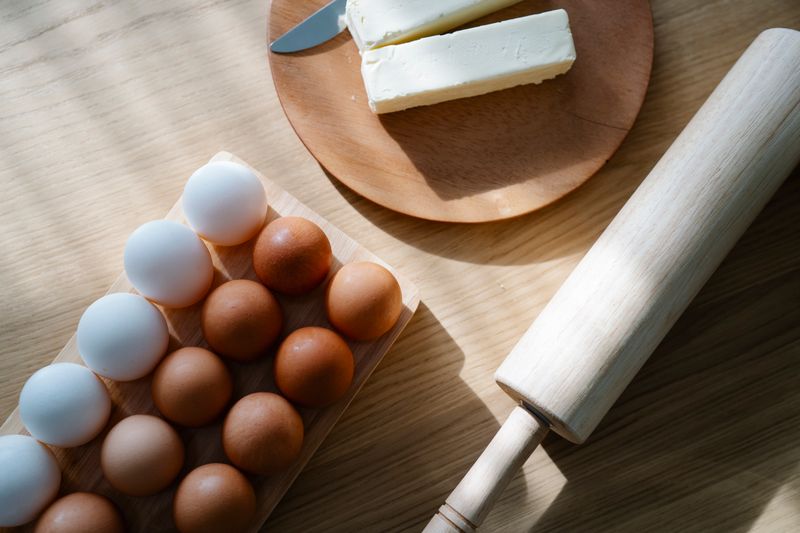
European-style butters with around 82 to 84 per cent fat contain less water and stay plastic across a slightly wider range. Standard butters at 80 per cent have more water, which makes them more likely to crack when cold and leak when warm. Some bakers beat the butter block between parchment sheets to work it into a pliable slab before locking it in.
That beating also warms it, so a short chill afterwards brings it back to a usable firmness.
The butter block should bend without snapping when you flex a corner, which is the practical test.
Rolling technique
Roll from the centre outwards in both directions rather than back and forth over the whole sheet. Even pressure keeps the butter layer uniform; heavy pressure at one end pushes butter towards the other. Keep the edges square, because rounded corners mean the butter does not reach them and those areas lose their layers.
Brush off excess flour between folds, since trapped flour absorbs butter and thickens the layers unevenly. If butter breaks through the surface, flour the spot lightly, chill immediately, and continue rather than starting again.
Domestic ovens routinely run twenty degrees off their dial, so trust a thermometer over the setting.
Signs it is working
A correctly laminated dough shows faint parallel striations at the cut edge, visible as thin light and dark lines. The dough should feel cool, firm and slightly springy rather than tacky or greasy at any point. When baked, the layers should be distinct and separate, with an open honeycomb interior on a croissant.
A dense, bready interior with a greasy base means the layers merged before they had a chance to steam apart. Reading the cut edge before baking tells you most of what you need to know.
The takeaway
Keep dough and butter at the same cool firmness, and chill the moment either one softens.
Bake it badly once on purpose. The failure teaches more than the photograph.
Questions readers ask
Can I laminate in a warm climate at all?
Yes, but you will work in shorter bursts with more frequent chilling, and a cold work surface becomes close to essential. Some bakers work at night or briefly chill the entire kitchen area they are using.
Does margarine laminate more easily than butter?
Specialist pastry margarines have a much wider plastic range and are genuinely easier to work with, which is why commercial bakeries use them. The trade is flavour and mouthfeel, since they melt at a higher temperature than body heat.
Also by Sabyasachi Roy
- Creaming butter and sugar is aeration, and the sugar crystals do the cuttingCakes & Sponges
- Reverse creaming gives a tighter crumb, and here is why it worksCakes & Sponges
- A genoise has no baking powder, so what is lifting itCakes & Sponges
- Baking powder and bicarbonate of soda are not interchangeableCakes & Sponges