Pastry
Shortcrust is rubbed in, not creamed, and that is the whole point
Coating flour particles in fat before the water arrives is what keeps pastry short. Cream the butter instead and you get a biscuit, or worse, a tough sheet.
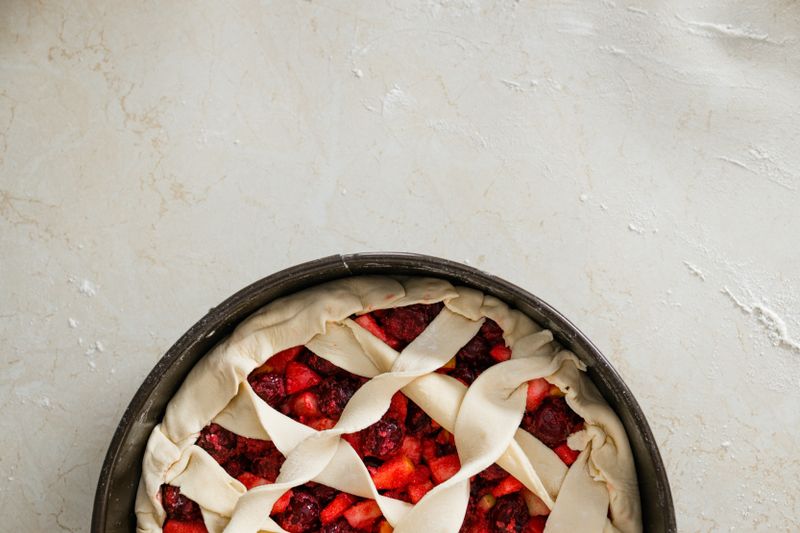
Everything below about the rubbing-in method comes from what actually happens rather than from what is supposed to.
What holds up in practice
- Fat coats the flour and blocks gluten formation.
- Use cold butter and the minimum water that brings it together.
- Rest the dough before rolling and again after lining the tin.
What short means
Short refers to short gluten strands, so a short pastry is one where gluten has been prevented from forming long networks. Rubbing cold butter into flour coats each particle in fat, so when water arrives it cannot hydrate the proteins freely.
The result crumbles rather than stretches, which is exactly what you want under a tart filling. A pastry that has been overworked stretches and then shrinks in the tin, and eats tough rather than crumbly. Every instruction in a shortcrust recipe is aimed at that single outcome.
Butter temperature and size
The butter should be cold and firm, cut into cubes of roughly one centimetre before you start. Rub with fingertips rather than palms, lifting the mixture as you go so air cools it and body heat has less contact. Stop when the mixture resembles coarse breadcrumbs with a few pea-sized pieces remaining.
Once the crumb sets, those larger pieces melt in the oven and leave small flaky pockets, which is desirable in a savoury crust. If the mixture starts to look pasty or clump into a dough, the butter has warmed and needs a spell in the fridge.
Water is the dangerous ingredient
Water is what activates gluten, so the goal is the smallest quantity that will bring the dough together. Add it a tablespoon at a time, tossing with a knife rather than stirring, and stop while the mixture still looks ragged. Press the ragged mixture together with your hands into a disc, which hydrates it enough without further mixing.
Ice-cold water helps mainly by keeping the butter firm during this stage rather than through any effect on the flour. Too much water gives a dough that is easy to roll now and shrinks badly later, which is a genuinely misleading trade.
Resting matters twice
A thirty minute rest in the fridge after mixing lets the water distribute evenly and the gluten relax. Rolling then requires less force, which itself reduces further gluten development. After lining the tin, rest again for another thirty minutes or freeze for fifteen, so any tension introduced during lining relaxes.
This second rest is what stops the sides of a tart case sliding down during blind baking.
Skipping either rest is the most common cause of shrunken, uneven tart shells.
Enrichments and what they do
Egg yolk adds fat and emulsifier and makes a richer, more biscuit-like pastry that handles well. Sugar in a sweet pastry tenderises further but also makes the dough softer and more prone to tearing.
Ground almonds replace some flour with something that cannot form gluten at all, which is very forgiving. A little vinegar or lemon juice is sometimes added, and while the effect on gluten is modest, it does no harm. Each addition makes the dough more fragile to handle and more tender to eat, which is the same trade in both directions.
Domestic ovens routinely run twenty degrees off their dial, so trust a thermometer over the setting.
Rolling and lining
Roll between two sheets of parchment if the dough is rich, since it avoids adding extra flour that dries the pastry. Turn the dough a quarter turn between passes to keep it round and to avoid stretching it in one direction.
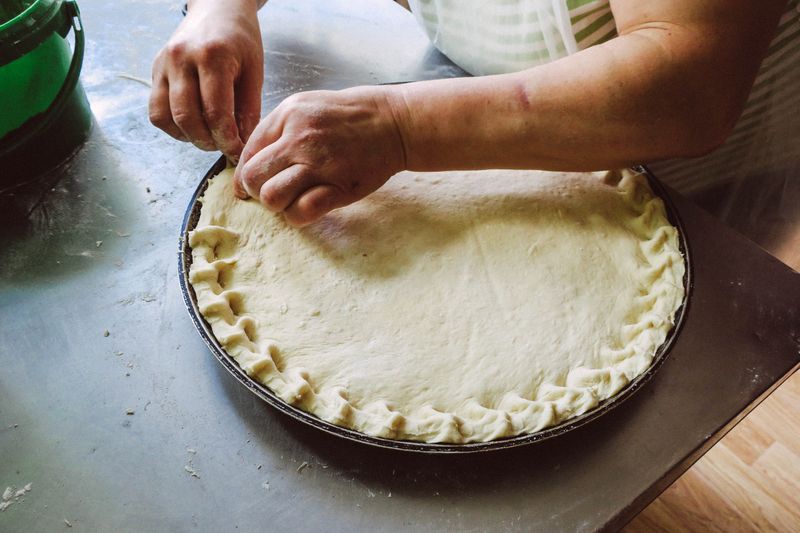
Lift the pastry into the tin rather than stretching it, because stretched pastry contracts back during baking. Press it gently into the corners so there is no air gap, and leave an overhang to trim after baking. Patching cracks with spare dough and a dab of water is entirely normal and invisible once filled.
The takeaway
Cold butter, minimum water, two rests, and resist the urge to knead it smooth.
Temperature and time are the same argument held at opposite ends.
Questions readers ask
Can I make shortcrust in a food processor?
Yes, and it keeps the butter colder than fingers do. Pulse rather than run it, and stop while the mixture is still crumbly, since a processor goes from breadcrumbs to a ball in about two seconds.
Why is my pastry tough even though I barely handled it?
Most likely too much water, or a strong bread flour rather than plain. Both let gluten form easily regardless of how gently you worked the dough.
Also by Sabyasachi Roy
- Creaming butter and sugar is aeration, and the sugar crystals do the cuttingCakes & Sponges
- Reverse creaming gives a tighter crumb, and here is why it worksCakes & Sponges
- A genoise has no baking powder, so what is lifting itCakes & Sponges
- Baking powder and bicarbonate of soda are not interchangeableCakes & Sponges