Pastry
Croissant butter sits near 25 per cent of the dough, and there is a reason
Too little and the layers merge into bread. Too much and the butter cannot be contained during rolling, so it leaks and the structure never forms.
This works through butter ratio in croissant dough in the order the parts actually depend on each other.
The short version
- Lock-in butter is commonly 25 to 30 per cent of the détrempe weight.
- Three letter folds give 27 butter-separated layers.
- Proving temperature must stay below the butter melting point.
The two doughs
A croissant is a yeasted dough, called the détrempe, wrapped around a block of butter and folded repeatedly. The détrempe is typically a lean-ish dough at around 55 to 60 per cent hydration, with a little sugar, milk and salt.
The lock-in butter commonly runs at twenty five to thirty per cent of the détrempe weight, so a kilo of dough takes 250 to 300g. Below about twenty per cent, the layers are too thin to separate properly and the result eats like a rich bread roll. Above about thirty five per cent, the butter becomes very difficult to contain and tends to break through during rolling.
Fold counts and layer maths
Three letter folds triple the layers each time, giving twenty seven layers of dough separated by twenty six of butter. Some bakers use a book fold and a letter fold for a similar count with one fewer rolling session. More folds than that make each butter sheet so thin it is absorbed into the dough and the honeycomb disappears.
This is the opposite of puff pastry, where a much higher layer count is desirable because there is no yeast. The yeast is doing part of the lifting, so the layers can and should be thicker.
Proving without melting
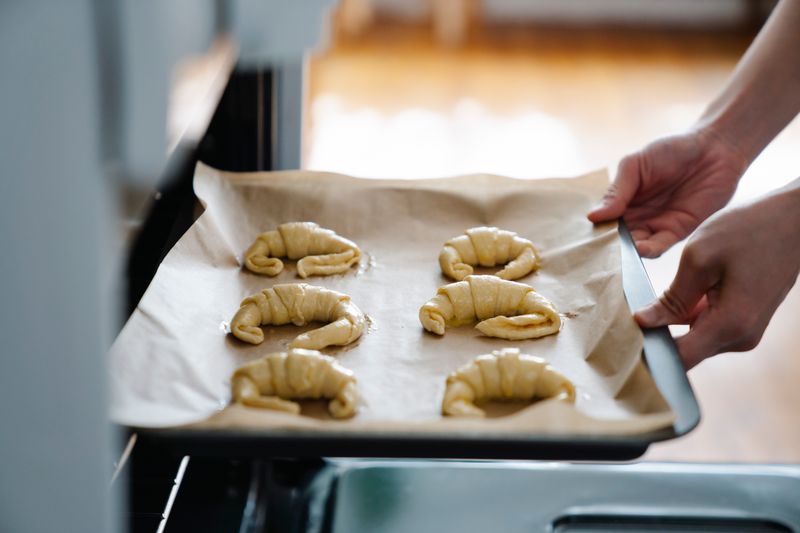
Shaped croissants must prove at a temperature below the butter melting point, which means somewhere around 24 to 26C. At 30C or above the butter softens and runs out of the layers before the oven ever gets involved. A proper prove takes two to three hours at that lower temperature, which is slower than most people expect.
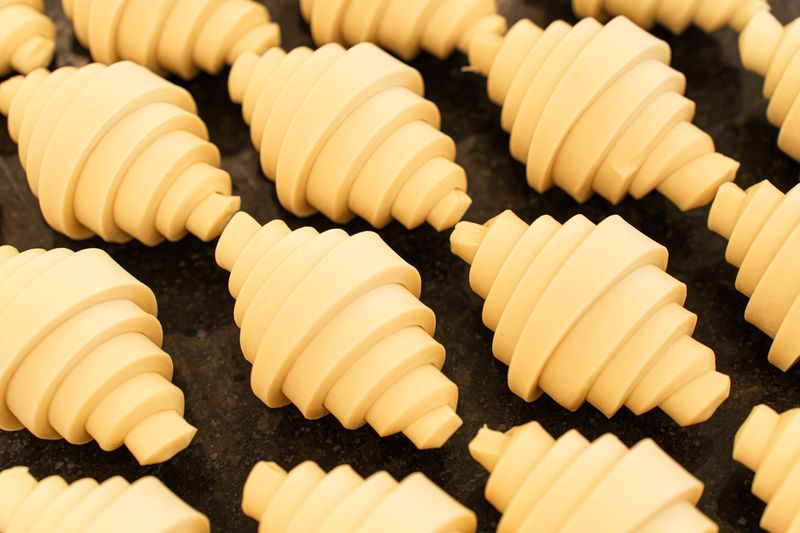
By the second rise, the croissants are ready when they have visibly grown, feel airy and jiggle as a unit when the tray is nudged. You should be able to see the layers separated at the cut ends, like the rings of a spring.
The bake
Start hot, typically 200 to 220C, so the water flashes to steam and pushes the layers apart before the butter melts entirely. Some of the butter does render out and fries the layers, which is where the crisp, shattering exterior comes from. After ten to twelve minutes, dropping to around 190C lets the interior finish without the exterior burning.
Weighed out, an egg wash applied thinly gives colour, but a thick wash glues the layers at the edges and restricts the rise.
A well made croissant will show an open, irregular honeycomb crumb with visible strands rather than a uniform interior.
Where the butter usually escapes
A pool of butter on the tray means the layers broke, and the two usual causes are warm proving and torn lamination. Check the shaped croissants before proving: any visible butter on the surface will become a leak. Rolling too thin at the final stage also tears the butter sheets, particularly at the edges of the sheet.
Sealing the ends of the triangle before rolling helps contain the layers as they expand. A small amount of butter on the tray is normal and produces the fried base; a pool is a failure.
Domestic ovens routinely run twenty degrees off their dial, so trust a thermometer over the setting.
Scaling and practicality
Home ovens rarely fit more than eight to twelve croissants at once, which is a sensible batch size for one détrempe. The process spans two days comfortably: mix and laminate on day one, shape and retard overnight, prove and bake in the morning.
Once the crumb sets, shaped croissants freeze well before proving and can be thawed and proved directly, which is how many bakeries operate. Trying to compress the whole thing into one afternoon is where most home attempts go wrong. The dough rewards patience far more than it rewards skill with a rolling pin.
The takeaway
Quarter of the dough weight in butter, three folds, and prove somewhere cooler than feels right.
Patience is an ingredient, and it is the one people leave out.
Questions readers ask
Do I need a special high-fat butter?
It helps, since 82 to 84 per cent fat butters are more plastic and contain less water. Standard butter works if you keep the temperature tightly controlled, but it is less forgiving.
Why is my croissant interior dense and bready?
Either the layers merged during rolling because the butter got warm, or the dough was underproved so the layers never separated. Check the cut end before baking, since the ring structure is visible there.
Also by Sabyasachi Roy
- Creaming butter and sugar is aeration, and the sugar crystals do the cuttingCakes & Sponges
- Reverse creaming gives a tighter crumb, and here is why it worksCakes & Sponges
- A genoise has no baking powder, so what is lifting itCakes & Sponges
- Baking powder and bicarbonate of soda are not interchangeableCakes & Sponges