Pastry
Resting pastry is hydration and relaxation, not a superstition
Two separate things happen during a rest, and knowing which one you need tells you whether thirty minutes is enough or three hours is necessary.
This works through resting pastry dough in the order the parts actually depend on each other.
The short version
- Gluten relaxes over roughly 30 minutes at fridge temperature.
- Water needs time to distribute evenly through the flour.
- A cold rest also firms the fat, which matters for handling.
Gluten relaxation
Rolling and kneading stretch gluten strands, and stretched gluten behaves elastically, pulling back towards its original length. Given time, the protein bonds rearrange and the dough loses that tension, which is why a rested dough rolls without fighting.
Thirty minutes at fridge temperature covers most of the relaxation for a shortcrust, and an hour covers nearly all of it. Warmer resting relaxes gluten faster but softens the fat, which is usually the wrong trade in pastry. A dough that keeps springing back after a proper rest was overworked rather than under-rested.
Hydration evens out
When water is added it does not distribute instantly; some flour particles are soaked while others are still dry. Over an hour or so the water migrates, giving a more uniform dough that rolls evenly and bakes consistently. This is why a dough that felt slightly dry when mixed often feels perfect after resting, with no water added.
Adding more water to a stiff dough before resting is the classic way to end up with a tough pastry. Mix, wrap, wait, and only then judge whether it needs anything.
Fat firming
A cold rest resolidifies butter that softened during mixing, restoring the distinct pieces that give flakiness. For laminated doughs this is at least as important as the gluten relaxation and often the main reason for the rest.
At oven temperature, fridge temperature of three to five degrees brings butter back to a firm, workable state within about thirty minutes for a thin sheet. A thick block takes considerably longer, which is why laminated doughs rest as flat rectangles rather than balls. The freezer firms too fast and unevenly, giving a hard shell around a soft centre.
Resting after shaping
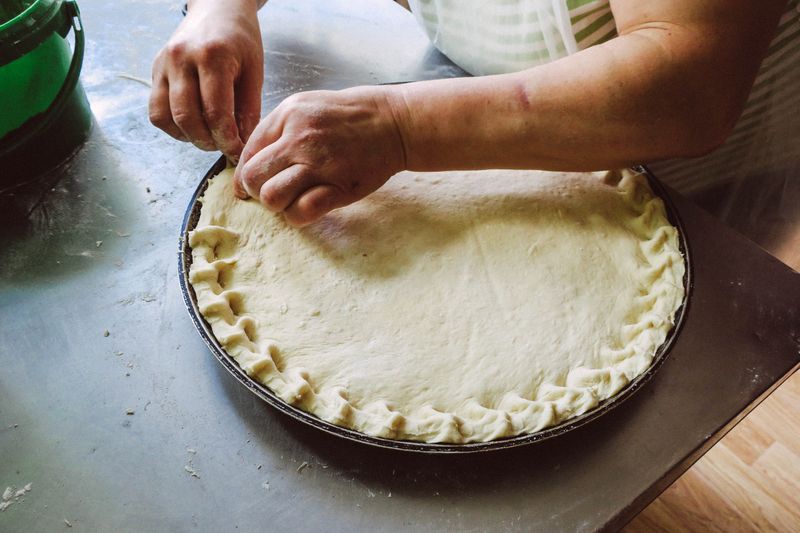
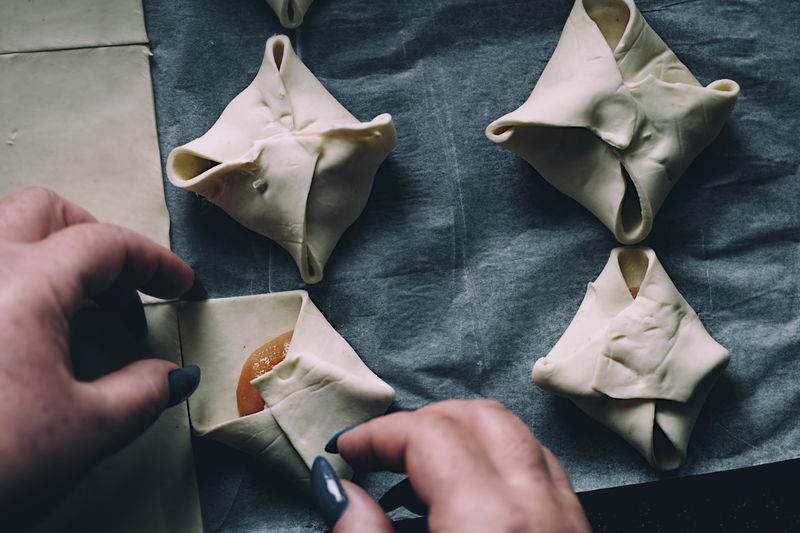
Lining a tart tin introduces new tension as the pastry is pressed and pushed into the corners. A second rest of thirty minutes after lining, before baking, is what prevents the walls sliding down. Cut puff pastry shapes should rest too, since cutting relieves tension unevenly and the pieces distort in the oven.
Freezing shaped pastry for fifteen minutes achieves the same at speed for thin pieces.
This second rest is skipped far more often than the first, and it causes more visible problems.
How long is too long
A shortcrust keeps in the fridge for two or three days wrapped tightly, though it will need ten minutes out to become rollable. Beyond that, oxidation dulls the flavour and the surface can dry into a skin that cracks when rolled. Doughs containing egg and dairy have a shorter useful life and should be used within a couple of days.
Weighed out, freezing is the better answer for longer storage, and pastry freezes extremely well for a month or more. Thaw in the fridge overnight rather than at room temperature so the fat and dough soften together.
Domestic ovens routinely run twenty degrees off their dial, so trust a thermometer over the setting.
When you genuinely can skip it
Very high fat, low water doughs such as some biscuit pastries have almost no gluten development to relax. Doughs made in a processor with ice-cold butter and minimal water are already close to evenly hydrated. Even then, a short chill improves handling, which is often the practical reason to rest rather than the structural one.
The dough tells you first: if the dough rolls easily, holds its shape and does not shrink, the rest has done its job or was not needed. The test is behaviour, not the clock on the wall.
The takeaway
Rest once after mixing and once after shaping, and let the dough tell you when it has stopped fighting.
Bake it badly once on purpose. The failure teaches more than the photograph.
Questions readers ask
Should pastry rest in the fridge or at room temperature?
The fridge for almost all pastry, because you want the fat firm as well as the gluten relaxed. Room temperature resting is only sensible in a very cold kitchen where the dough is already too hard to roll.
Can I rest the dough as a ball or does the shape matter?
Flatten it into a disc or rectangle before wrapping. A ball chills unevenly and needs more rolling to reach shape, which reintroduces the tension you were trying to remove.
Also by Sabyasachi Roy
- Creaming butter and sugar is aeration, and the sugar crystals do the cuttingCakes & Sponges
- Reverse creaming gives a tighter crumb, and here is why it worksCakes & Sponges
- A genoise has no baking powder, so what is lifting itCakes & Sponges
- Baking powder and bicarbonate of soda are not interchangeableCakes & Sponges