Pastry
Docking, venting and giving the steam somewhere to go
Pastry rises because water turns to steam. Deciding where that steam escapes, and whether it escapes at all, is a choice you make before it goes in the oven.

There is a short answer about venting steam in pastry and a useful one, and they are not the same. What follows is the useful one.
The short version
- Docking holes let steam out of a flat base so it stays flat.
- A pie lid needs a vent or the filling forces the seams open.
- Do not dock pastry you want to rise.
What steam does in the oven
Pastry contains water in the dough and, in laminated pastry, in the butter as well. Above 100C that water flashes to steam and expands to many hundreds of times its liquid volume. That expansion is the primary lifting force in puff, filo and choux, and it is a considerable one.
In a flat tart base or a pie lid, the same force is a nuisance that lifts and distorts the pastry. Docking and venting are simply ways of choosing whether that force works for you or against you.
Docking a base
Pricking a rolled base all over with a fork creates channels for steam to escape before it can lift the sheet. The holes should go right through the pastry, since a partial prick does nothing useful.
The dough tells you first: a docking roller with spikes does the same job faster and more evenly on large sheets. Do this on flat bases, tart cases that will not be blind baked with weights, and any pastry you want to stay level. Never dock puff pastry you want to rise, because you will have removed the mechanism that lifts it.
Venting a pie
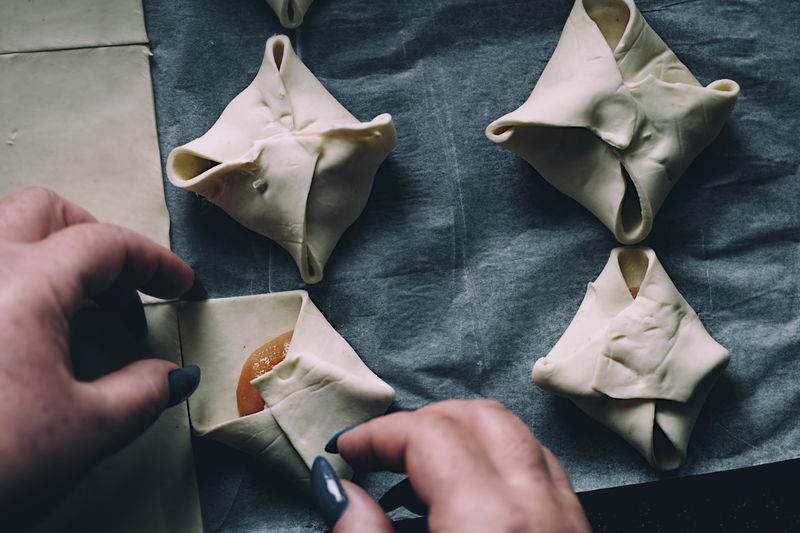
A closed pie with a wet filling generates a great deal of steam under a sealed lid. With no exit, the pressure lifts the lid away from the filling and forces the crimped edge open at its weakest point. A single hole in the centre, or a few small slashes, releases that pressure in a controlled way.
A pie funnel or a rolled paper chimney does the same and keeps the hole from sealing over during baking. Fruit pies benefit particularly, since fruit collapses as it cooks and leaves a gap the steam fills.
Controlled rise on a tart border
For a tart with a raised border, score a line a centimetre or two from the edge without cutting through. Then dock the inner area thoroughly and leave the border untouched, so only the rim lifts. This gives a neat frame around a flat base that holds a filling without it running off.
At oven temperature, egg washing only the border rather than the whole surface keeps the base pale and the rim glossy.
The technique is standard for tomato, onion and frangipane tarts and takes about a minute.
Weighting for a flat result
Some pastries are deliberately baked flat under a second tray, particularly for millefeuille layers. The weight compresses the rise into a dense, even, crisp sheet with visible thin layers.
The dough tells you first: bake between two sheets of parchment with a heavy tray on top, checking after fifteen minutes. Removing the top tray for the last few minutes lets the surface dry and caramelise. This is a case where you have made a great deal of lift and then chosen not to use it.
Reading the failures
A tart base that has bubbled into a dome was not docked, or the holes did not go all the way through. A pie with a burst side seam and filling on the tray had nowhere for its steam to go.
A puff pastry lid that stayed flat was either docked by accident or had its edges sealed by a blunt knife. A soggy pie lid underneath usually means steam condensed against it rather than escaping. In every case the question is the same: where did you expect the steam to go?
The takeaway
Decide before baking whether you want lift or flatness, then dock, vent or weight accordingly.
Bake it badly once on purpose. The failure teaches more than the photograph.
Questions readers ask
Should I dock a case that will be blind baked with weights?
It is optional, since the weights already hold the base down. A few holes do no harm and give some insurance if the weights do not fill the case properly.
Why did my pie vent seal itself closed during baking?
The pastry relaxed and the hole shrank, which is common with a soft or thick lid. A pie funnel, or reopening the hole once the lid has set, keeps the channel open.
Also by Sabyasachi Roy
- Creaming butter and sugar is aeration, and the sugar crystals do the cuttingCakes & Sponges
- Reverse creaming gives a tighter crumb, and here is why it worksCakes & Sponges
- A genoise has no baking powder, so what is lifting itCakes & Sponges
- Baking powder and bicarbonate of soda are not interchangeableCakes & Sponges