Pastry
Sweet pastry is fragile because sugar and yolk are working against the flour
Pâte sucrée tears, cracks and crumbles during handling, and every one of those behaviours is a direct consequence of what makes it good to eat.

These are listed in the order worth acting on, which with sweet pastry handling is not the order they are usually presented in.
What matters most
- Sugar and yolk both limit gluten, which is why the dough is weak.
- Roll between parchment sheets rather than adding flour.
- Patch cracks with raw dough rather than re-rolling.
Why it is so delicate
Sugar dissolves in the small amount of water present and competes for it, leaving less available to hydrate the flour proteins. Egg yolk brings fat and lecithin, which coat flour particles and further limit gluten formation.
The result is a dough held together mostly by fat and set sugar rather than by any protein network. That is exactly what makes the baked pastry snap crisply and melt rather than chew. The fragility during handling and the quality on the plate are the same property viewed from two sides.
The creaming approach
Unlike shortcrust, sweet pastry is often made by creaming butter and sugar first, then adding egg and finally flour. This distributes the fat and sugar very evenly and gives a smooth, homogeneous dough with almost no gluten. The flour goes in last and is mixed only until it disappears, which takes seconds rather than minutes.
Overmixing at that stage is one of the few ways to make this pastry tough. The finished dough should be soft and slightly sticky, and it firms considerably once chilled.
Rolling without adding flour
Extra bench flour dries the dough and makes it more likely to crack, so avoid it where possible. Roll between two sheets of baking parchment, which lets you turn and lift the sheet without touching it.
If the dough softens as you work, slide the whole parchment sandwich into the fridge for ten minutes. Rolling straight from the fridge is usually too firm, so allow five minutes at room temperature first. Aim for two to three millimetres, which is thin enough to be crisp and thick enough to survive lining.
Lining a tin
Peel off the top parchment, invert the sheet over the tin, and peel the second sheet away once it is in place. Ease the pastry down into the corners rather than stretching it across, since stretched pastry contracts in the oven.
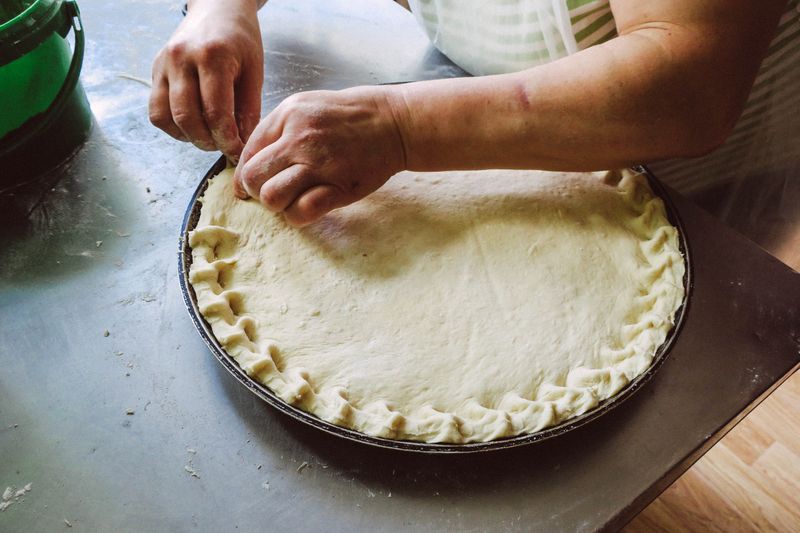
The dough tells you first: use a small ball of spare dough to press the pastry into the fluted edge without your fingertips tearing it. Leave the excess hanging over the rim and trim after baking, which gives a clean edge and allows for shrinkage. Cracks and tears are expected; press a little raw dough into them and carry on.
Chilling and baking
Chill the lined case for at least thirty minutes, or freeze for fifteen, before it goes near the oven. Sweet pastry burns more readily than plain because of its sugar content, so bake at around 160 to 170C. Blind bake with weights until the sides are set, then uncovered until the base is dry and lightly golden.
In the tin, watch the last few minutes closely, since the transition from golden to too dark takes very little time. A finished case should be uniformly pale gold and should snap rather than bend when you tap the edge.
Repairing after the bake
Small cracks in a baked case can be sealed with a little beaten egg brushed on and returned to the oven for two minutes. Melted chocolate brushed over the interior seals larger flaws and doubles as a moisture barrier.
Weighed out, a case with a genuine hole can be patched with raw dough and rebaked, though the join will show. None of this matters once a filling and a topping are in place, so repair rather than restart. Sweet pastry offcuts also bake into perfectly good biscuits, so nothing needs to be wasted.
Everything above, in order of what to do first
- Why it is so delicate. Sugar dissolves in the small amount of water present and competes for it, leaving less available to hydrate the flour proteins.
- The creaming approach. Unlike shortcrust, sweet pastry is often made by creaming butter and sugar first, then adding egg and finally flour.
- Rolling without adding flour. Extra bench flour dries the dough and makes it more likely to crack, so avoid it where possible.
- Lining a tin. Peel off the top parchment, invert the sheet over the tin, and peel the second sheet away once it is in place.
- Chilling and baking. Chill the lined case for at least thirty minutes, or freeze for fifteen, before it goes near the oven.
- Repairing after the bake. Small cracks in a baked case can be sealed with a little beaten egg brushed on and returned to the oven for two minutes.
The takeaway
Handle it as little as possible, patch what tears, and accept that fragile raw means crisp baked.
Bake it badly once on purpose. The failure teaches more than the photograph.
Questions readers ask
Can I use plain shortcrust for a sweet tart instead?
You can, and it will be easier to handle and less crisp to eat. The difference is most noticeable in a tart where the pastry is thin and the filling is soft, such as a lemon tart.
Why does my sweet pastry spread and lose its shape in the oven?
The butter was too soft when it went in, so it melted before the structure set. A longer chill before baking, and a hot preheated sheet under the tin, both help it set faster than it slumps.