Bread
Rye holds a loaf together with pentosans, not with gluten
A rye dough that behaves like wheat is a rye dough with very little rye in it, and the difference is not stubbornness but chemistry.
This looks at baking with rye flour from the practical end — what holds up once conditions stop being ideal.
What holds up in practice
- Rye proteins cannot form a gluten network the way wheat does.
- Pentosans, a family of gums in the bran, do the water holding instead.
- Acidity from a sour starter controls rye enzymes and sets the crumb.
Why rye will not behave like wheat
Rye contains proteins related to those in wheat, but they are diluted and disrupted by other components that prevent a continuous elastic network forming. You can knead a rye dough as long as you like and it will never pass a windowpane test, because the network is not there to build.
What you get instead is a sticky, paste-like mass that behaves far more like a thick batter than a dough. Treating that stickiness as a sign of too much water is the standard mistake, and adding flour only makes a drier brick. The moment you stop expecting elasticity, rye stops feeling like a failure and starts feeling like a different material.
What pentosans do instead
Pentosans are long chain sugars concentrated in the bran layers, and rye carries far more of them than wheat does. They absorb several times their own weight in water and form a viscous gel that traps gas without needing protein strands. That gel is what gives rye bread its close, moist, slightly sticky crumb and its unusually long keeping quality.
At oven temperature, it is also why a rye dough feels tacky however it is handled, since the water is held in a gum rather than a network. The trade is that gas is held less efficiently, which is why rye loaves rise less and sit denser than wheat loaves.
Why rye almost always means sourdough
Rye flour carries high enzyme activity that breaks starch down into sugars faster than the starch can set during baking. Left unchecked, that activity produces a crumb that is gummy and wet in the middle regardless of how long the loaf bakes. Acidity slows those enzymes down, which is the functional reason rye breads across northern and eastern Europe are traditionally soured.
A rye sourdough is therefore not a stylistic choice but a technical requirement for anything above a small proportion of rye. Adding a little acid to a yeasted rye dough achieves something similar, though a mature rye starter does the job more reliably.
Handling a high rye dough
Wet hands, a wet scraper and a wet work surface do far more than flour, which the dough simply absorbs and rejects. Shaping is really smoothing, since there is no network to tension and no benefit in trying to build one.
Most high rye loaves are baked in a tin for the simple reason that the dough cannot hold its own shape. The surface is usually smoothed with a wet hand rather than scored, because a rye crust cracks in its own pattern as it bakes.
Expect a shorter, denser loaf than a wheat bake of the same weight, and judge success on crumb quality rather than height.
Blending rye into a wheat loaf
A small proportion of rye adds flavour, colour and keeping quality while leaving the wheat gluten firmly in charge of structure. As the proportion climbs, the dough becomes stickier, rises less and needs a shorter fermentation to avoid collapsing. Somewhere in the middle range the loaf stops behaving like wheat bread with a rye accent and starts behaving like rye bread.
That crossover is where most home bakers get caught out, having scaled up a recipe that worked at a lower proportion. Increasing rye a little at a time across successive bakes is the only reliable way to find where your flour and method give up.
Domestic ovens routinely run twenty degrees off their dial, so trust a thermometer over the setting.
Cooling and cutting a rye loaf
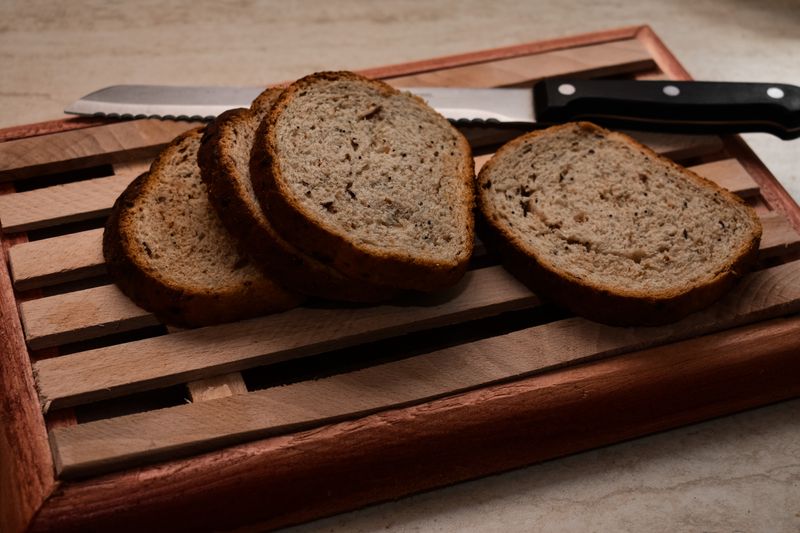
Rye crumb continues to set for a long time after baking, as the pentosan gel firms and moisture redistributes through the loaf. Cutting too early gives a wet, claggy slice that would have been perfectly good if left wrapped for a day. The traditional practice of leaving a rye loaf a full day before slicing is a texture instruction rather than a superstition.
The dough tells you first: the same slow set is why rye keeps well, since the gel holds water that a wheat crumb would have given up to the air. Store it wrapped rather than open, and accept that the first slice is always the least representative one.
The takeaway
Stop trying to build gluten in rye, and start managing gums, enzymes and acid instead.
Bake it badly once on purpose. The failure teaches more than the photograph.
Questions readers ask
Can I make rye bread with commercial yeast alone?
At low rye proportions yes, since the wheat is doing the structural work and enzyme activity stays manageable. At high proportions you need acidity, either from a rye starter or from an added acid, or the crumb will be gummy.
Why is my rye dough so sticky when the recipe seemed dry?
Pentosans hold water in a gum rather than a network, so the surface stays tacky even in a relatively stiff dough. Use water on your hands and tools rather than adding flour to fix a feel that is not a hydration problem.