Bread
The windowpane test measures one thing, and it can still mislead you
A dough can pass the windowpane and still bake dense, because gluten development and gas retention are related but not the same property.
This works through the windowpane test in the order the parts actually depend on each other.
The short version
- The test shows extensibility and film strength, not fermentation state.
- Wholemeal and rye will never windowpane properly.
- Time and folds develop gluten as effectively as kneading does.
What the test actually shows
Stretching a small piece of dough until light passes through it tells you the gluten strands have aligned enough to form a continuous film. That film is what traps carbon dioxide, so the test is a reasonable proxy for whether the dough can hold gas at all.
What it cannot tell you is whether the dough has fermented enough, been shaped well or has any gas in it yet. A perfectly windowpaned dough that is then underproved and badly shaped will still bake into a brick. It answers one question well and is silent on the three others that decide the loaf.
Doing it properly
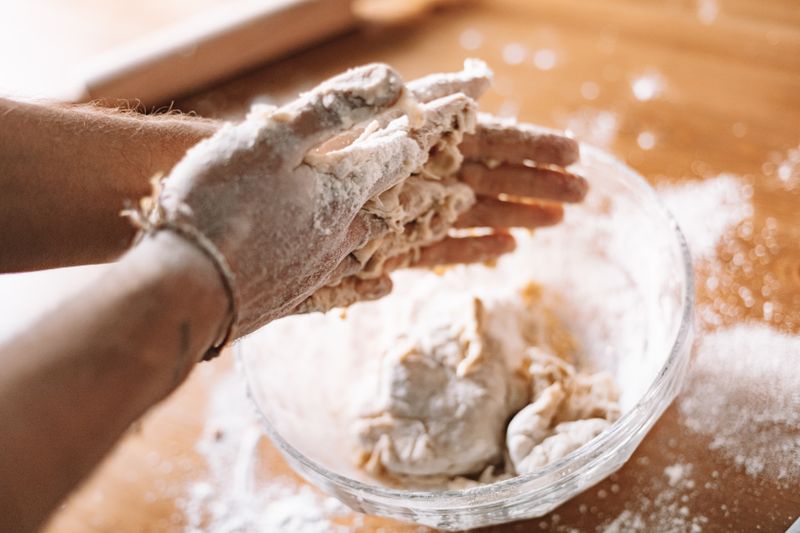
Take a piece roughly the size of a walnut from the edge of the dough rather than the middle, so you are not deflating the mass. Stretch slowly from the centre outwards with all four fingers, rotating as you go, because sudden pulls tear a dough that would otherwise pass.
The dough tells you first: you are looking for a translucent membrane you can see fingers through, with a smooth edge if it eventually tears. A ragged tear at low extension means the gluten is underdeveloped; a smooth tear at full stretch is entirely acceptable. Warm dough stretches further than cold, so a fridge-cold sample will fail a test it would have passed at 24C.
Where it does not apply
Wholemeal flour carries bran particles with sharp edges that physically cut the gluten film as it thins. The dough may be fully developed and still tear at half the extension a white dough manages, which is not a fault.
In the tin, rye has very little gluten-forming protein and relies on pentosans for structure, so the test is meaningless there. Very high hydration doughs also tend to pass early and easily, because the strands slide past each other with little resistance. In all three cases you judge by feel and by how the dough behaves during folds instead.
Kneading is not the only route
Gluten forms whenever glutenin and gliadin are hydrated and moved against each other, and time does a great deal of that work unaided. A no-knead dough left for twelve hours will windowpane without ever being worked, because slow hydration and fermentation gas do the alignment. Four sets of stretch and fold at half hour intervals typically reach the same point as eight minutes of machine mixing.
The mixer is faster, not better, and it introduces friction heat that pushes the dough temperature up several degrees.
Choosing between them is a scheduling decision more than a quality one.
Overworking is real but rare by hand
It is genuinely difficult to overmix a dough by hand, because you tire before the gluten network breaks down. In a stand mixer at high speed it is entirely possible, and the dough turns shiny, slack and soupy without recovering. Once the network has been mechanically torn past that point, no amount of resting brings it back.
Mixing at low or medium speed and checking every two minutes past the six minute mark avoids the problem completely. Oxidation from very long mixing also bleaches flavour compounds, which is why long-mixed commercial bread tastes flat.
Domestic ovens routinely run twenty degrees off their dial, so trust a thermometer over the setting.
Using the test as one signal
Treat the windowpane as a gate you pass through early rather than a finish line you aim at. Once it passes, your attention should move entirely to dough temperature, fermentation progress and shaping tension. If a loaf is dense despite a good windowpane, the fault is almost certainly proving or shaping, not development.
At oven temperature, keeping the two categories separate in your head stops you kneading harder to fix a problem kneading cannot touch. Most home bakers overwork the mixing stage and underwork the judgement stages that follow it.
The takeaway
Pass the windowpane early, then spend your attention on temperature and shaping instead.
Patience is an ingredient, and it is the one people leave out.
Questions readers ask
How long should kneading take before it passes?
By hand, expect eight to twelve minutes of active work on a 65 to 70 per cent white dough. In a stand mixer on medium, six to eight minutes is typical, though friction will raise the dough temperature while it happens.
Does adding salt later make gluten develop faster?
Slightly, because salt tightens the gluten network and slows hydration. The effect is small enough that most bakers add salt with the water and lose nothing measurable.