Baking Science
Recipes Scale Badly Because Surface Area Does Not Follow Volume
Doubling a recipe doubles the mass but increases the surface far less, so heat has further to travel and the bake needs a different temperature and time rather than the same ones.

Scaling a recipe by multiplying the ingredients is arithmetic. Scaling the bake is geometry, and the two do not move together.
Volume grows faster than surface
Doubling the linear dimensions of a tin multiplies its volume eightfold while multiplying its surface area only fourfold.
Heat enters through the surface and has to reach every part of the volume, so a larger bake has proportionally less entry area for far more material.
The distance from surface to centre also grows, and conduction through a batter is slow, so the centre lags further behind than the size difference suggests.
The consequence is an overbaked outside
Holding the temperature constant, the outer regions sit at oven heat for far longer while the centre catches up.
That produces a dry, dark crust and an overcooked band inside it, with the correct texture only in the middle.
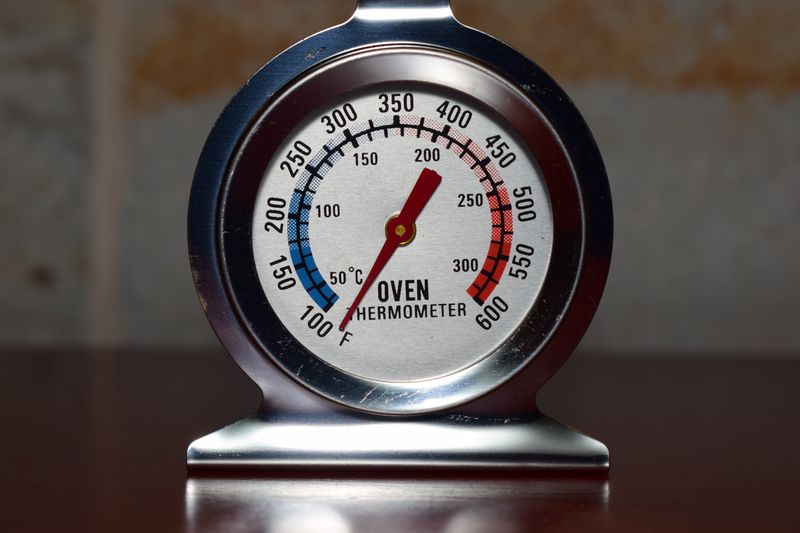
The standard correction is to lower the temperature and extend the time, so the heat gradient across the bake is gentler and the outside is not punished.
Depth matters more than width
Spreading the same increased quantity across a wider tin at the same depth barely changes the bake, since the distance to the centre is unchanged.
Doubling the depth changes it a great deal, because the centre is now twice as far from any surface and heat has to travel through cooked material to get there.
This is why recipes specify tin size so precisely, and why substituting a deeper tin of the same volume is the substitution most likely to fail.
Some ingredients do not scale linearly either
Chemical leavening in a deep bake produces gas that has further to travel, and an amount correct for a shallow cake can over-inflate and collapse a deep one.
Salt and strong flavourings are perceived in proportion to concentration, so they scale straightforwardly, but leavening and yeast interact with time and depth.
Yeast is the clearest case, since a larger dough mass retains its own fermentation heat and warms itself, running faster than a small batch would.
Practical approaches to scaling up
Baking multiple tins of the original size avoids the problem entirely and is why commercial bakeries scale by count rather than by size.
Where a large single bake is needed, lowering the temperature substantially and protecting the outside with lining or an outer water bath is the usual approach.
Testing for doneness by internal temperature rather than by time becomes essential, since published times refer to a size the bake no longer is.
Questions readers ask
Does altitude affect pastry as much as cake?
Much less, since pastry relies on steam and fat rather than on chemical leavening holding a delicate structure. The main effect is faster drying, which can be countered with a slightly wetter dough.
Is there one adjustment that helps most?
Reducing the chemical raising agent is usually the single most effective change for cakes. It directly addresses the over-expansion that causes the collapse.
Also by Gaurav Bhattacharya
- Baker's percentages let you rescale, compare and diagnose any recipeBaking Science
- Amylase, falling number and why bakers add malt to flourBaking Science
- A set of one gram scales is the cheapest upgrade in the kitchenTins & Tools
- Your oven dial is a suggestion and a cheap thermometer proves itTins & Tools