Bread
Open crumb is a structure you build, not a hydration number you copy
Adding water to chase big holes usually produces a flat loaf with a wet crumb, because hydration is one input among several and rarely the limiting one.

What follows is the working version of building an open crumb: the decisions in the order you actually meet them, with the reasoning attached.
Before you start
- Gas cell size is set by gluten strength, degassing and handling.
- Hydration only helps if the network can hold it.
- Every stage from mixing to scoring either preserves cells or destroys them.
What an open crumb actually is
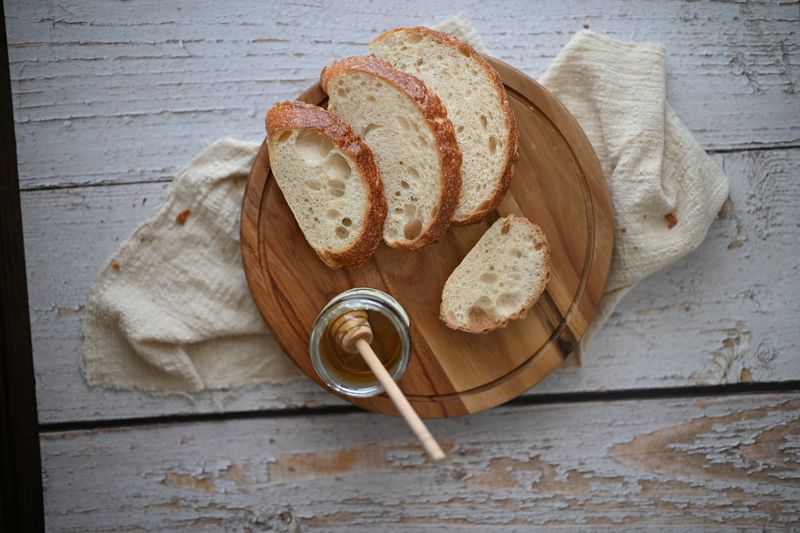
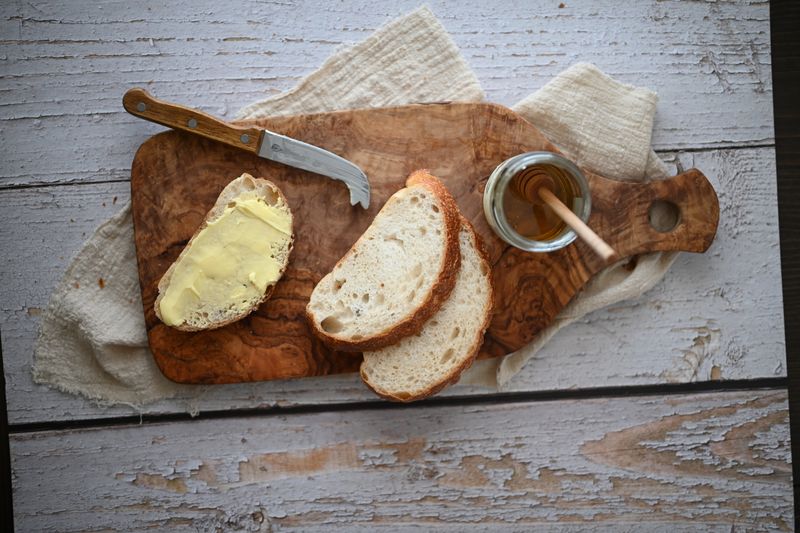
The holes in a slice of bread are gas cells that grew, merged and then had their walls set by heat before they could collapse. Large, irregular holes mean cells were allowed to merge, which needs walls thin and extensible enough to stretch rather than tear. A tight crumb means cells stayed small and separate, either because they were degassed or because the network never let them merge.
Neither is better in the abstract, and a sandwich loaf with large holes is a worse sandwich loaf. Deciding which crumb you want before you start makes every subsequent choice much easier to reason about.
Why water alone does not do it
Water makes a dough more extensible, which helps cell walls stretch instead of tearing as the gas inside them expands. Past a point, though, the network becomes too weak to hold the gas at all, and the loaf spreads rather than rises. That point depends on the flour, so a hydration that works with one bag produces a puddle with another.
In the tin, adding water to a flour that cannot support it gives a flat loaf with a wet, close crumb, which is the opposite of the intention. The useful sequence is to build as much strength as the flour allows first, then add water while the dough still holds.
Preserving the cells you have made
Every action after fermentation begins either keeps gas in the dough or pushes it out, and there is no neutral handling. Aggressive kneading late in bulk, hard degassing before shaping and very tight shaping all reduce the final cell size.
The dough tells you first: gentle folds, a light preshape and a shaping method that builds surface tension without crushing the interior all preserve it. Bakers chasing an open crumb usually change their handling long before they change their hydration. The dough should be treated as something inflated that you are trying not to puncture, rather than something to be worked.
Fermentation and the size of the holes
Underfermented dough has small cells and little gas, so it bakes tight regardless of how gently it was handled. Well fermented dough has plenty of gas in cells that have had time to merge into larger, irregular ones.
Overfermented dough has a weakened network, and its large cells collapse rather than setting, which reads as a flat loaf with a dense base. The open crumb window sits close to the overproved edge, which is why it is harder to hit consistently than a tight crumb.
It is also why a loaf can be visibly more open one week and tight the next with no change to the recipe at all.
Oven conditions that let cells expand
Gas expands sharply when the dough hits the oven, and the cell walls have to stretch for the crumb to open any further. A crust that sets early stops that expansion, which is why steam early in the bake matters for crumb as well as for shine.
Strong heat from below drives the initial expansion, so a preheated stone, steel or heavy pot changes the crumb noticeably. Scoring gives the expansion somewhere to go, and a loaf that cannot open at the cut will tear somewhere less useful. A cool oven produces a slower rise, a thicker crust and a tighter crumb even from a perfectly fermented dough.
Weigh rather than scoop wherever a recipe leaves you the choice.
Deciding whether you want it
Very open crumbs hold less filling, drip more and toast unevenly, which is a real cost rather than a purist complaint. An even, moderately open crumb is more useful for most eating and harder to achieve than either extreme.
In the tin, photographs reward extreme openness in a way that daily eating does not, which distorts what home bakers aim for. Judging your loaf on flavour, crust and how well it slices is a better standard than counting holes in a photograph. If you do want openness, change one variable per bake and note what happened, since the interactions are too tangled to guess.
The takeaway
Build strength, ferment fully, handle gently, and the holes will follow without chasing a hydration figure.
Temperature and time are the same argument held at opposite ends.
Questions readers ask
Does a wetter dough always give a more open crumb?
Only up to the point where your flour can still hold the water, and past that the loaf spreads and closes up. Strength and handling usually limit the crumb long before hydration does.
Why is my crumb open at the top and dense at the bottom?
That pattern usually means the dough was overproved, or the base of the loaf was compressed while it was still slack. Shortening the final proof and baking with strong heat from below both help.