Tins & Tools
Stand mixer, hand mixer or hands: what each is actually good at
The three tools are not ranked. Each does one part of baking better than the others, and knowing which is which saves both money and effort.
There is a short answer about choosing a mixer for baking and a useful one, and they are not the same. What follows is the useful one.
The short version
- Stand mixers excel at long kneading and sustained creaming.
- Hand mixers are better for small quantities and warm bowls.
- Hands are the only tool that tells you what the dough is doing.
What a stand mixer is for
A stand mixer with a dough hook handles stiff or heavily enriched doughs that are genuinely unpleasant to knead by hand. It is also the only practical way to sustain a five minute creaming or a ten minute meringue without your arm giving out.
The bowl capacity matters more than the motor power for most home use, since underfilled bowls mix poorly. Friction from the hook raises dough temperature by two to four degrees over a typical mix, which you should account for. It is a large, expensive object that earns its place only if you bake regularly.
What a hand mixer does better
A hand mixer works in any bowl, including one over a pan of water, which a stand mixer cannot do. That makes it the right tool for warm meringue methods and for anything where you need to control temperature. It handles small quantities that would sit below the beater in a large stand mixer bowl.
It costs a fraction as much, stores in a drawer and covers most cake making perfectly well. It will not knead bread dough, and attempting it usually burns out the motor.
What hands do that machines cannot
Your hands give continuous feedback about how the dough is developing, which no machine provides. You can feel when a dough goes from shaggy to smooth, when it becomes extensible and when it starts to weaken. That information is the basis of almost every judgement in bread making.
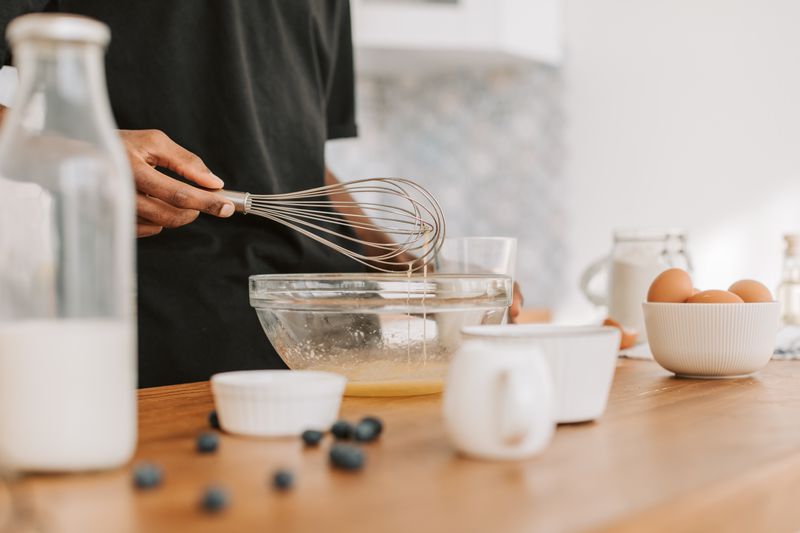
Hand mixing also avoids friction heating and makes overmixing effectively impossible for most people. Stretch and fold techniques replace kneading entirely and take about two minutes of actual work spread over three hours.
Matching tool to task
For a lean bread dough at 70 per cent hydration, hands and folds are as good as any machine and often better. For brioche at 50 per cent butter, a stand mixer is close to essential unless you enjoy an hour of work. For creaming butter and sugar, either machine works and hands take four times as long for a worse result.
The dough tells you first: for folding flour into a foam, only hands and a spatula are appropriate, since any machine deflates it.
For pastry, cold fingers or a food processor both work and a stand mixer is the wrong shape for the job.
Attachments worth using
The paddle is for creaming, batters and anything where you want mixing without gluten development. The dough hook is for bread, and the spiral shape works better than the C-shape for wet doughs. The balloon whisk is for foams, and using it on a stiff batter will bend it out of shape.
Weighed out, using the wrong attachment is a common cause of poor results, particularly the hook on a cake batter. Scraper paddles with a silicone edge remove most of the need to stop and scrape the bowl.
Domestic ovens routinely run twenty degrees off their dial, so trust a thermometer over the setting.
Speed discipline
Almost every mixing fault in a home kitchen comes from running a machine faster than necessary. High speed on a dough hook heats the dough and can tear the gluten network past recovery.
Weighed out, high speed on a cake batter drives out the air you creamed in and develops gluten unnecessarily. Low to medium covers nearly everything, with high speed reserved for whipping cream and egg whites. Stopping to check every couple of minutes is worth far more than any amount of extra motor power.
The takeaway
Use the machine where it saves real effort and your hands where they tell you something.
Bake it badly once on purpose. The failure teaches more than the photograph.
Questions readers ask
Can a food processor knead bread dough?
It can, and quickly, but it heats the dough considerably and gives you almost no feedback. It is much better suited to pastry, where speed and cold butter are exactly what you want.
Do I need a stand mixer to make good bread?
No. Time, folds and a reasonable hydration will develop gluten as thoroughly as any machine. A mixer saves effort on stiff and enriched doughs, which is a convenience rather than a quality advantage.
Also by Gaurav Bhattacharya
- Baker's percentages let you rescale, compare and diagnose any recipeBaking Science
- Altitude changes every leavened recipe, and pressure is the reasonBaking Science
- Amylase, falling number and why bakers add malt to flourBaking Science
- A set of one gram scales is the cheapest upgrade in the kitchenTins & Tools