Pastry
Pecan Pie Filling Is A Custard Built Around Syrup
The filling sets because egg proteins coagulate, and the corn syrup that dominates its flavor also controls crystallization and keeps the set soft rather than firm.

Pecan pie filling looks like a candy and behaves like a custard. Its set comes from egg protein coagulating, with syrup and sugar governing how firm that set turns out.
Egg is doing the structural work
The filling is liquid until the egg proteins unfold with heat and bond into a network that traps everything else in place.
That is the same mechanism as a baked custard or a quiche, occurring in a much sweeter medium.
Remove the egg and the filling never sets. It cooks down into a syrup that pours out the moment the pie is cut.
Sugar raises the temperature the egg needs
Dissolved sugar interferes with proteins finding each other, so a heavily sweetened custard coagulates at a higher temperature than a plain one.
This is why a pecan filling can be baked longer than a savory custard without immediately curdling. The sugar is buying tolerance.
Past that tolerance the same failure appears: the protein network contracts too hard and squeezes liquid out, leaving a weeping, grainy filling.
Corn syrup is there for texture, not only sweetness
Corn syrup contains sugars that interfere with crystal formation, which keeps the filling smooth rather than developing a gritty texture as it cools.
It also holds water tightly, so the set stays soft and slightly sticky instead of drying into something hard.
Substituting granulated sugar alone gives a filling that is sweeter in a flatter way and much more likely to turn sandy after a day in the refrigerator.
Maple syrup and molasses behave somewhere between the two, bringing their own flavor and enough non-crystallizing sugars to keep the set reasonably smooth.
The nuts float and that is intentional
Pecans are less dense than the filling around them, so they rise during baking and set as a layer across the top.
That layer shields the custard beneath from direct radiant heat, which slows the surface set and reduces cracking.
It also toasts, which contributes most of the roasted flavor. Nuts stirred in and submerged taste noticeably flatter.
The crust is racing the filling
A wet filling poured into raw pastry keeps the crust below its browning temperature for much of the bake, which is how a soggy bottom happens here.
Blind baking the shell first, and placing the pie low in the oven where the base gets more heat, are both attacks on the same timing problem.
The filling is done when the center still moves slightly as a unit, because the set continues from residual heat after the pie leaves the oven.
A pie baked until the center is completely firm in the oven is already past that point, and it cools into a filling that is rubbery rather than soft.
Questions readers ask
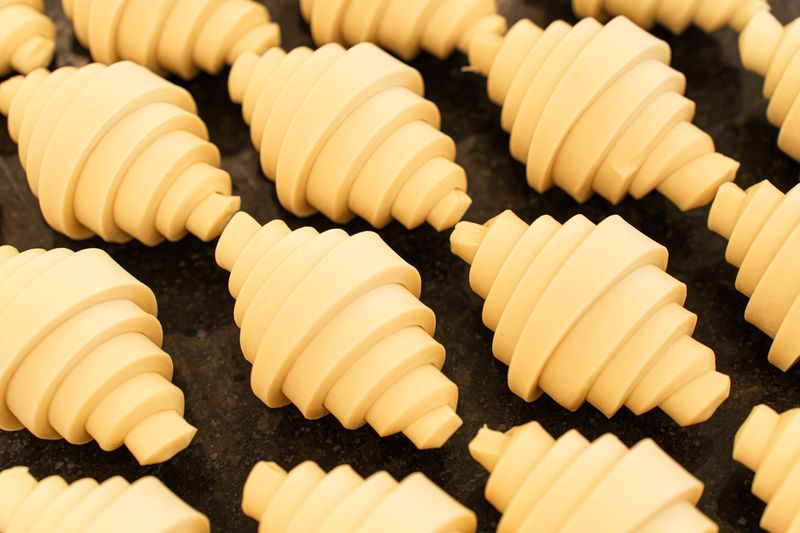
Can I make croissants entirely in one day?
You can, but every rest becomes the minimum rather than the comfortable option and the margin for error disappears. Splitting the work across two days is easier and generally gives better results.
Does a laminated dough need a bulk fermentation before lamination?
Recipes differ, and many give the dough only a short rest before chilling, relying on the long cold stages for flavour. A long warm bulk before lamination usually leaves too little fermentation capacity for the final proof.