Pastry
Puff Pastry Needs A Clean Cold Edge To Rise Straight
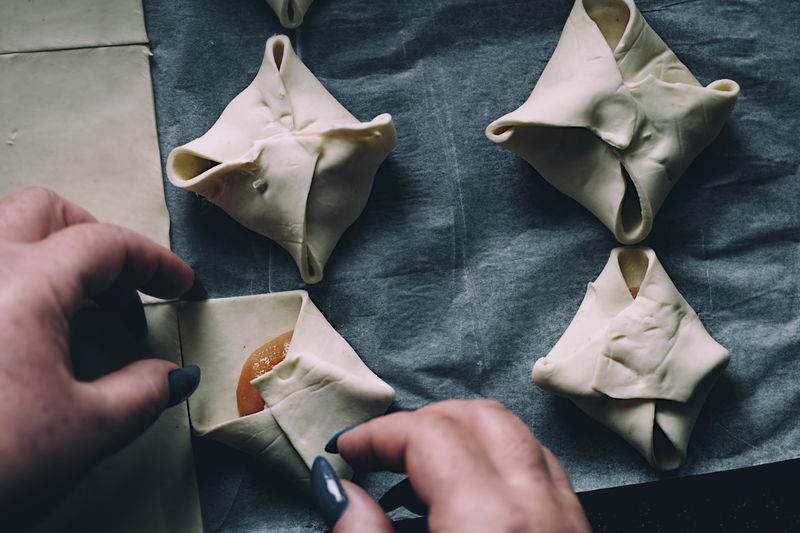
The cut face is where laminated layers separate, so anything that seals, drags or warms that edge prevents the pastry lifting evenly and produces a leaning, stunted bake.

Puff pastry that rises unevenly or falls sideways is usually diagnosed as a lamination problem. Very often the lamination is fine and the cutting was not.
The cut edge is where lift happens
In the middle of a sheet, layers are enclosed and steam separates them internally. At a cut edge, the layers are open and free to move apart.
That open face is what produces the visible leaves and most of the height at the border of a vol-au-vent or a palmier.
Anything that closes it prevents the separation, and the pastry rises only where its edges remain free.
Blunt tools seal the layers shut
A blunt cutter or a knife pressed slowly through the dough compresses the layers at the edge and welds the fat and dough together.
The seal survives the bake, so that section stays flat while the rest lifts, producing a pastry that leans away from the sealed side.
A sharp blade pressed straight down in one movement severs without dragging. Sawing and rocking both smear the layers sideways.
Warm pastry deforms rather than cutting
Fat in a warm laminated dough is soft, so a blade pushes it aside instead of cutting through it and the layers merge at the edge.
Cold pastry cuts cleanly because the fat is firm enough to fracture rather than smear, which is why the sheet is chilled immediately before cutting.
Cutting straight from the fridge and returning the cut pieces to chill before baking is standard practice for exactly this reason.
Egg wash is a glue in the wrong place
Egg wash sets into a firm film during the bake, and any that runs down a cut edge bonds the layers there permanently.
Applying it with a light hand to the top surface only, and away from the edges, avoids this while still giving colour and shine.
The same caution applies to any liquid at the border, including fillings that leak. A wet edge is a sealed edge.
Docking and weighting are deliberate seals
Where flat pastry is wanted, the same mechanisms are used on purpose. Docking with a fork pins layers together so the base cannot lift.
A border left undocked will rise while the docked centre stays flat, which is how a tart with a raised rim is produced from a single sheet.
Baking under a second tray flattens the pastry entirely, giving the dense, crisp, many-layered sheet used in layered slices rather than an airy puff.
Questions readers ask
Can I make croissants entirely in one day?
You can, but every rest becomes the minimum rather than the comfortable option and the margin for error disappears. Splitting the work across two days is easier and generally gives better results.
Does a laminated dough need a bulk fermentation before lamination?
Recipes differ, and many give the dough only a short rest before chilling, relying on the long cold stages for flavour. A long warm bulk before lamination usually leaves too little fermentation capacity for the final proof.