Pastry
Re-Rolled Puff Pastry Rises Less Because Its Layers Are Now Random
Trimmings from a laminated dough have layers running in every direction, so the steam that once lifted a uniform stack now pushes in conflicting directions and gives less height.

Offcuts from puff pastry never bake like the sheet they came from. The dough is unchanged chemically, and what has been destroyed is its geometry.
Lamination is an ordered structure
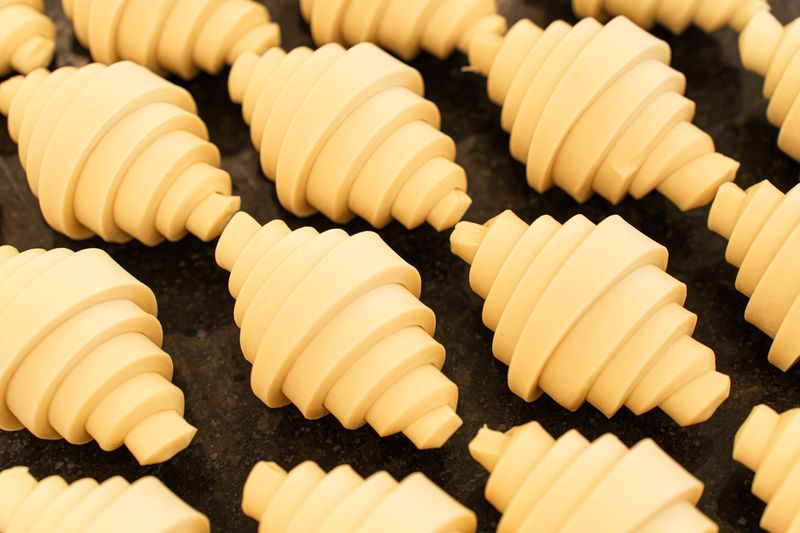
A laminated dough is a stack of alternating dough and fat layers, all lying flat and parallel across the whole sheet.
When it bakes, water in each dough layer turns to steam and pushes the layer above it directly upward. Every layer's contribution points the same way.
That coordination is where the height comes from. The lift is not from any one layer but from all of them acting in the same direction.
Gathering the scraps destroys the alignment
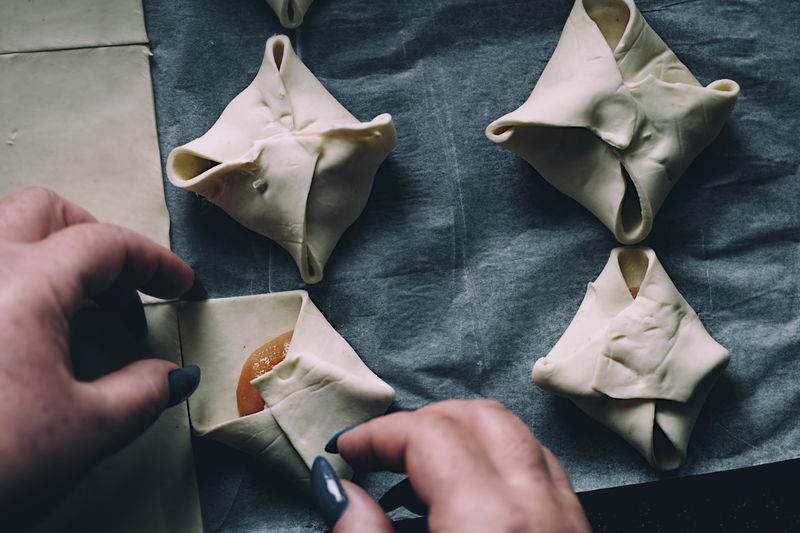
Bundling offcuts together puts layers at every angle, with cut edges and folded sections meeting each other in no particular order.
On baking, the steam still forms, but neighbouring regions push in different directions and partly cancel one another out.
The pastry still puffs, just far less and unevenly, and it tends to twist or lean as one region lifts more than its neighbour.
Stacking beats squashing
Pressing scraps into a ball is the worst option, because it randomises the layers completely and works the dough besides.
Laying offcuts flat on top of one another in the same orientation, then rolling gently, preserves a rough alignment and recovers a useful share of the rise.
Chilling between handling matters more than usual here, since the fat in trimmings has already been worked and warmed once.
Re-rolled pastry has its own uses
Anything that does not need height is well served by it: tart bases, palmiers, cheese straws, pie linings and anything topped and weighed down.
The flavour and the flakiness are unaffected, so the pastry eats well even where it fails to rise dramatically.
Bakers who plan for this cut the sheet to leave usable rectangles rather than awkward slivers, and keep a separate use in mind before cutting.
Cutting technique protects the layers you have
A blunt cutter presses the layers together at the edge and seals them, and a sealed edge cannot separate into leaves during the bake.
A sharp knife or cutter used in a single downward motion severs cleanly and leaves the layers free to lift at the cut face.
Egg wash running down a cut edge does the same thing as a blunt blade, gluing the layers shut, so washing is kept to the top surface.
Questions readers ask
Can I make croissants entirely in one day?
You can, but every rest becomes the minimum rather than the comfortable option and the margin for error disappears. Splitting the work across two days is easier and generally gives better results.
Does a laminated dough need a bulk fermentation before lamination?
Recipes differ, and many give the dough only a short rest before chilling, relying on the long cold stages for flavour. A long warm bulk before lamination usually leaves too little fermentation capacity for the final proof.