Baking Science
Conduction, convection and radiation each bake a different part of the loaf
An oven delivers heat in three ways at once, and knowing which one is reaching which surface explains most uneven bakes.
Treat the sections below as a sequence. With heat transfer in an oven, getting the early decisions right makes the later ones much easier.
Before you start
- Conduction from the tin or stone bakes the base.
- Convection from moving air bakes the sides and surface.
- Radiation from the elements browns whatever faces them.
The three routes heat takes
Conduction moves heat through direct contact, which is what happens between a hot tray and the base of a bake. Convection moves heat by the movement of air, carrying it around the oven and against every exposed surface. Radiation travels as infrared energy from hot elements and hot oven walls to whatever is in line of sight.
All three are working simultaneously in any oven, and their balance changes with the oven type and the shelf position. Most baking faults that look mysterious are a mismatch between which route dominates and what the bake needed.
Why the base is a conduction problem
A loaf sitting on a thin tray receives heat only as fast as that tray can absorb and pass it on. A preheated stone or steel holds a large amount of energy and delivers it quickly to whatever touches it. That surge of heat from below is what drives oven spring in bread and what crisps a pizza base.
At oven temperature, a cold tray placed into a hot oven takes time to heat, and the bake sitting on it starts slowly. This is the mechanism behind every recommendation to preheat a surface rather than the oven alone.
Why fan ovens behave differently
A fan moves air continuously, which raises the rate at which heat reaches every exposed surface. That is why fan ovens are run at a lower setting than conventional ones for the same result. Moving air also strips away the humid layer that would otherwise sit against the surface of a bake.
Faster surface drying means faster crust formation, which helps a crusty loaf considerably and harms a cake that still needs to rise. Delicate items can be blown out of shape, which is why some recipes specify the fan should be off.
Radiation and the shelf you chose
Elements at the top or bottom of the oven radiate directly at whatever faces them without obstruction. A bake close to the top element browns on top rapidly and can scorch while the middle is unset.
By the second rise, a tray placed above another blocks that radiation, which is why two trays bake unevenly without swapping. Oven walls also radiate, so a bake pressed against one side colours faster on that side.
Covering a bake with foil is really a way of blocking radiation while leaving convection untouched.
Using the three deliberately
For bread, strong conduction from below and a humid start gives lift before the crust sets. For a rich cake, gentle even convection and reduced radiation from above gives a level top and a set centre.
In the tin, for pastry, high heat and strong conduction crisp the base before the filling can soak it. For meringue, gentle convection over a long period dries the structure out slowly rather than browning or setting it quickly. Every one of those is a choice about which transfer route to favour rather than simply a temperature.
Flour absorbs water differently by brand and by season; hydration is a target, not a rule.
Diagnosing an uneven bake
A dark base with a pale top points at strong conduction and weak radiation from above. A dark top with an underbaked centre points at radiation dominating before heat penetrated.
In the tin, one side darker than the other usually means the bake sat too close to a wall or the fan was uneven. A pale, soft base in a pastry case means not enough heat arrived by conduction at all. Once you can name the route, the fix is usually a different shelf, a different tin or a preheated surface.
The takeaway
Name the route the heat is taking, and an uneven bake stops being a mystery and becomes a shelf decision.
Temperature and time are the same argument held at opposite ends.
Questions readers ask
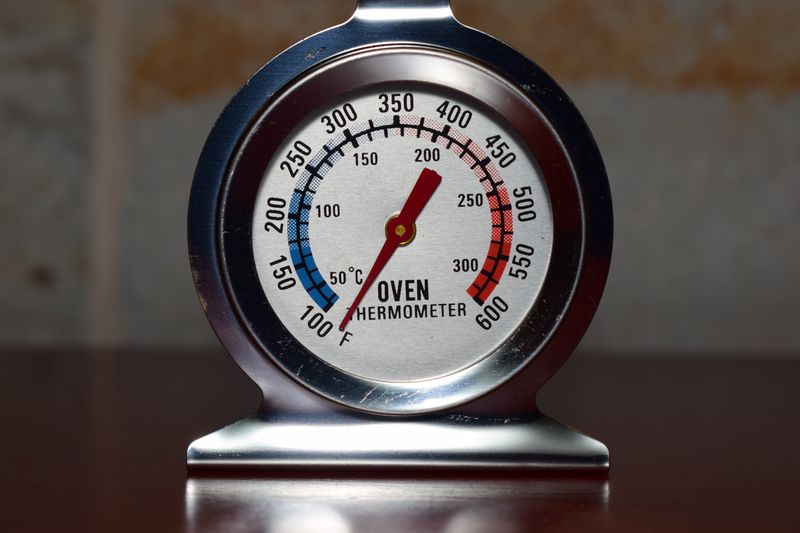
Does an oven thermometer tell me about all three?
No, it measures air temperature, which mostly reflects convection. Two ovens at the same reading can still bake very differently depending on their elements and mass.
Why does my bake improve on a lower shelf?
Usually because it is receiving less direct radiation from a top element and more conducted heat from below. That balance suits most bread and many pastries.
Also by Gaurav Bhattacharya
- Baker's percentages let you rescale, compare and diagnose any recipeBaking Science
- Altitude changes every leavened recipe, and pressure is the reasonBaking Science
- Amylase, falling number and why bakers add malt to flourBaking Science
- A set of one gram scales is the cheapest upgrade in the kitchenTins & Tools