Bread
Scoring a loaf is a controlled failure, and the angle does the work
The blade is not decoration. It chooses where the loaf will burst so the expansion goes where you want it rather than where the crust happens to be weakest.
What follows is the working version of scoring bread before baking: the decisions in the order you actually meet them, with the reasoning attached.
Before you start
- A shallow blade at 30 degrees creates an ear; a vertical cut opens flat.
- Score deep enough to matter, around 5 to 10mm.
- A wet or dull blade drags and deflates the dough.
Why a loaf needs a cut at all
As the loaf heats, gas expands and internal steam builds, and the taut skin you built during shaping has to give somewhere. Left alone it will tear at whichever point is weakest, usually along the seam or wherever the surface dried first. A deliberate cut is a planned weak point, and the loaf will open there in preference to anywhere else.
This is why an unscored loaf often has a strange bulge on one side and a compressed crumb opposite it. The pattern is aesthetic; the fact of the cut is structural.
The angle that produces an ear
Holding the blade at roughly thirty degrees to the surface cuts a flap of skin rather than a simple slit. As the loaf expands, that flap lifts and curls back, and the exposed dough beneath sets into the raised ridge bakers call an ear. A vertical cut at ninety degrees opens into a wide flat gap instead, which is the right choice for some shapes.
Once the crumb sets, the shallow angle only works with a genuinely sharp blade, since a dull one drags the flap instead of slicing it. A curved lame exaggerates the effect by lifting the flap slightly as the cut is made.
Depth and confidence
Most home scores are too shallow, barely breaking the surface, and the loaf then bursts elsewhere anyway. A depth of around five to ten millimetres on a standard loaf is usually right for a single decisive cut. Speed helps more than pressure, because a fast pass parts the dough before the surface tension can drag it.
Hesitating mid-cut leaves a ragged line that neither opens cleanly nor holds a shape. Practise on a spare shaped piece if the loaf feels too precious to risk.
One cut or several
A single long score down the length of a batard concentrates all the expansion in one place and gives the biggest ear. Multiple shorter cuts distribute the opening, which suits a round loaf and reduces the chance of an uncontrolled tear.
Decorative patterns with many fine cuts release pressure so evenly that the loaf tends to expand uniformly with no dramatic opening. Choose according to the effect you want, but know that more cuts generally means less height at any one point.
For a first sourdough, one confident cut teaches you more than a wheat sheaf pattern will.
The blade and the dough surface
A razor blade on a handle stays sharper than a kitchen knife and costs almost nothing to replace. Dipping the blade in water or wiping it with oil reduces drag on very wet doughs, though it can blur the line.
Cold dough straight from the fridge scores far more cleanly than room temperature dough, because the surface is firm. A light dusting of rice flour on the surface improves contrast and helps the blade cut rather than push. If the dough sticks to the blade and pulls, the dough is warm, wet or overproved rather than the blade being wrong.
Reading the result
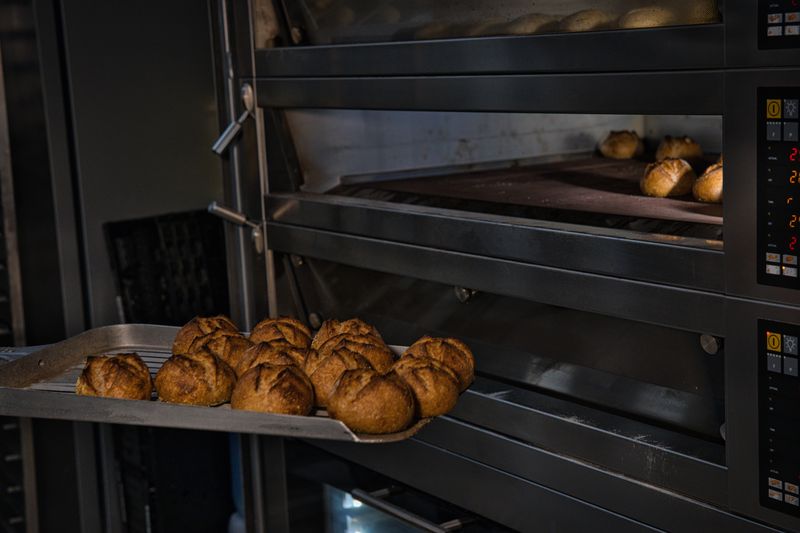
A loaf that opened cleanly along the score with a raised lip had good tension, good proving and enough steam. A score that barely opened suggests the dough was overproved and had no expansion left to give.
A burst at the base or side despite a score means the cut was too shallow or the crust set too early. Very jagged, torn edges point to a dull blade or hesitant technique rather than a fault in the dough. The score is the most legible record of the whole bake, once you know how to read it.
The takeaway
One sharp cut at a shallow angle, made without hesitation, is worth any amount of pattern.
Bake it badly once on purpose. The failure teaches more than the photograph.
Questions readers ask
Should I score enriched doughs and tin loaves?
Enriched doughs benefit from a shallow score for appearance but expand gently enough that it is rarely structural. Tin loaves are supported on three sides and often need no score at all.
Why does my score close up again during the bake?
That usually means the dough was overproved, so the gluten could not hold the opening. It can also happen if the loaf goes into an oven that is not hot enough to set the cut edges quickly.