Cakes & Sponges
Curdled cake batter is a broken emulsion and it costs you volume
The split you see when eggs go in too fast is fat and water separating. The cake still bakes, but with a coarser crumb and less rise than it should have had.
These are listed in the order worth acting on, which with split or curdled cake batter is not the order they are usually presented in.
What matters most
- Cold eggs are the most common cause of a split batter.
- A spoonful of flour stabilises the mixture immediately.
- A curdled batter loses air but is not ruined.
What is actually separating
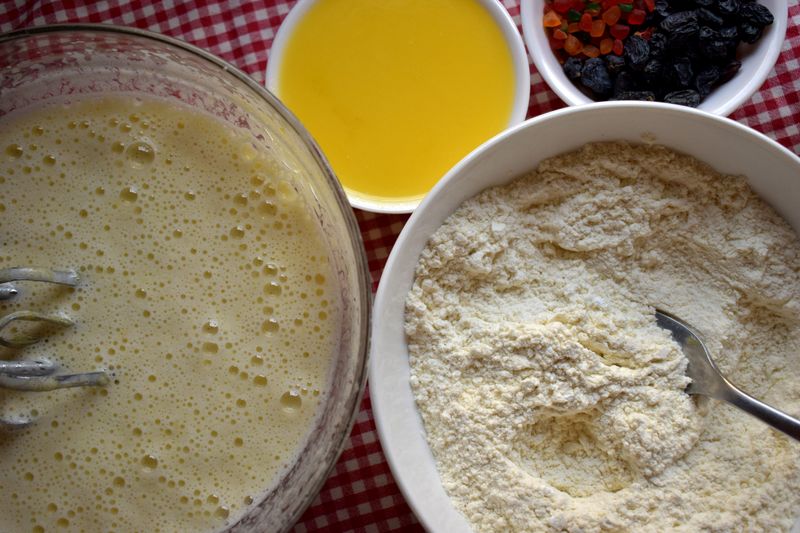
Creamed butter and sugar is a fat continuous mixture with air suspended in it, and egg is roughly three quarters water. Adding that water fast overwhelms the emulsion, and the fat pulls back into clumps with watery liquid between them. The air you whipped in was held in the fat structure, so when that structure breaks the bubbles escape.
The visible curdle is the symptom; the loss of aeration is the actual cost. That is why a split batter bakes into a slightly denser, coarser cake rather than an inedible one.
Temperature is the main lever
Eggs straight from the fridge at 4C hitting butter at 20C chill the fat locally and set it into lumps. Bringing eggs to room temperature, or standing them in warm water for ten minutes, removes the problem almost entirely.
The dough tells you first: the same applies to milk, buttermilk and yoghurt, which are added later but split the batter just as effectively. In a cold kitchen even room temperature eggs can be too cool, so a bowl of warm water is a reasonable habit. Warming the mixing bowl briefly before starting also helps in winter.
Rate of addition
Add eggs one at a time, or in five or six small pours if the recipe uses several, beating fully between each. Each addition should disappear completely before the next arrives, leaving a smooth, glossy, homogeneous mixture.
If the mixture starts to look grainy or shiny in a broken way, stop adding and beat for another thirty seconds. Beating longer often brings it back, because the mixer is being given time to re-disperse the water into the fat. Continuing to pour into a mixture that is already struggling is what turns a wobble into a full split.
The flour trick
A tablespoon of the measured flour added with the eggs absorbs free water and gives the emulsion something to cling to. This costs nothing, since the flour is going in anyway, and it rescues most batters that are on the edge.
Weighed out, ground almonds work the same way in recipes that include them and add tenderness at the same time. Do not add extra flour beyond what the recipe specifies, or the crumb will tighten noticeably. Use the trick preventively on recipes with a high egg to butter ratio, where splitting is close to inevitable.
When it splits anyway
Carry on. Add the remaining eggs, then fold in the flour, and the batter will usually come back together as the starch absorbs the loose water. The finished cake will be a little denser and may have a slightly more open, uneven crumb. It will not taste wrong, and frosting hides the difference entirely in most cases.
The dough tells you first: throwing out a split batter wastes ingredients over a defect that is largely cosmetic in the finished cake. Note what caused it, because the same recipe on the same day next time will do exactly the same thing.
Emulsifiers that help
Egg yolk contains lecithin, a natural emulsifier, so recipes using extra yolks are inherently more stable. This is one reason enriched batters with several yolks tolerate faster addition of liquid. Buttermilk and yoghurt bring acidity that also helps, though they must still be at room temperature.
Commercial cake mixes add synthetic emulsifiers precisely because they make the process foolproof. At home the equivalent is patience and temperature control rather than an additive.
Everything above, in order of what to do first
- What is actually separating. Creamed butter and sugar is a fat continuous mixture with air suspended in it, and egg is roughly three quarters water.
- Temperature is the main lever. Eggs straight from the fridge at 4C hitting butter at 20C chill the fat locally and set it into lumps.
- Rate of addition. Add eggs one at a time, or in five or six small pours if the recipe uses several, beating fully between each.
- The flour trick. A tablespoon of the measured flour added with the eggs absorbs free water and gives the emulsion something to cling to.
- When it splits anyway. Carry on. Add the remaining eggs, then fold in the flour, and the batter will usually come back together as the starch absorbs the loose water.
- Emulsifiers that help. Egg yolk contains lecithin, a natural emulsifier, so recipes using extra yolks are inherently more stable.
The takeaway
Room temperature eggs added slowly will prevent almost every split you have ever had.
Bake it badly once on purpose. The failure teaches more than the photograph.
Questions readers ask
Does a split batter change the baking time?
Slightly. A denser batter conducts heat a little differently and may need two or three minutes longer, so check with a skewer or probe rather than the stated time.
Can I fix it by adding more butter?
No. Adding fat to a broken emulsion usually makes it greasier rather than smoother. Warmth, continued beating and a spoonful of flour are the reliable responses.