Bread
The poke test reads gas pressure, and every dough answers differently
Pressing a finger into proving dough tells you something real, but what it tells you depends on the flour, the temperature and the shape you made.
Comparisons of judging the final proof usually pick a winner. This one picks the circumstances, which is more useful.
The difference in one place
- The dent measures how much internal pressure the gluten is under.
- Springing straight back means more time, staying flat means too much.
- Cold dough always reads firmer than the same dough at room temperature.
What your finger is actually measuring
A proving dough is a network under tension, inflated from the inside by gas that the yeast is steadily producing. Pressing into it compresses the gas cells and stretches the strands around them, and the speed of the rebound reflects both.
Early in the proof there is little gas and plenty of elasticity, so the dent vanishes almost as fast as you make it. Late in the proof the strands are stretched close to their limit and have lost most of their ability to snap back. The useful window sits between those two, where the dent fills slowly and does not quite disappear.
Reading the three answers
A dent that springs back immediately and completely means the dough still has structure and gas to spare, so give it longer. A dent that fills slowly and leaves a shallow trace is the classic ready signal, and the loaf should go into the oven.
A dent that stays exactly where you left it, sometimes with the surface sighing, means the network can no longer hold what is inside it. A dough that deflates around your finger has gone past recovery for that bake, though it will still make perfectly good bread. Push with a floured fingertip rather than a bare one, and press to about the depth of a fingertip rather than through to the bench.
Why temperature changes the reading
Cold gluten is stiffer and cold gas takes up less volume, so a dough straight from the fridge reads firmer than it really is. Retarded doughs are usually baked cold and judged by rise and feel rather than by a poke, which will mislead you every time.
A warm dough reads slack and can look overproved when it merely feels soft, which pushes bakers into baking too early. The same dough at two temperatures gives two different answers, so the test is only comparable against your own past bakes. Noting the dough temperature alongside what the poke felt like turns a vague impression into something you can repeat.
Why flour and hydration change it too
A strong flour dough holds tension longer and rebounds harder, so it can read underproved when it is genuinely ready. A wet dough or a wholemeal dough reads slack from the start, because the network is softer and the surface gives easily.
At oven temperature, enriched doughs are softest of all, since fat between the strands makes everything more yielding regardless of fermentation. For those doughs, volume and the way the loaf moves when the tin is nudged are better guides than a fingerprint.
The point is to learn what your usual dough feels like when it bakes well, rather than to match a description written elsewhere.
Signs to read alongside the dent
A dough at the right point looks slightly domed and airy, with a surface that has lost its earlier tautness. Small bubbles appearing under the surface skin are a reasonable sign that fermentation is well advanced. A shaped loaf that has spread sideways rather than upward has usually lost structure rather than gained proof.
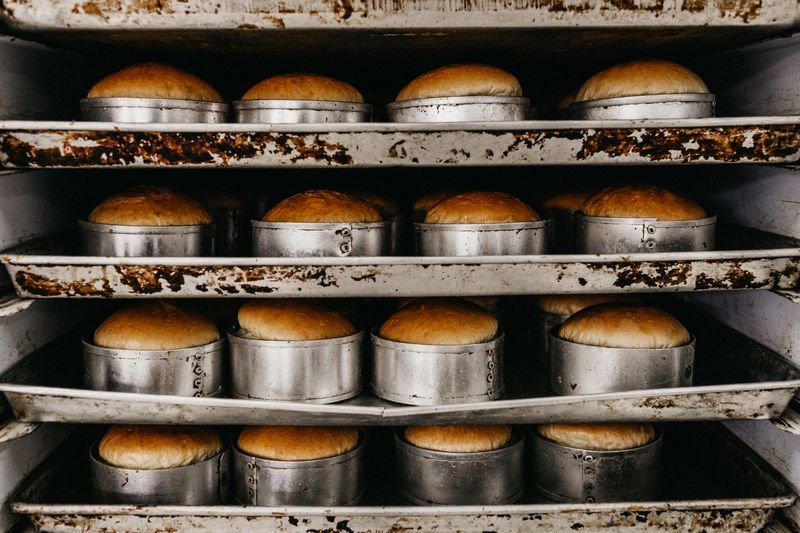
The dough tells you first: in a tin, the dough reaching the rim and beginning to dome above it is a more reliable marker than any finger test. Using two or three signals together catches the cases where any single one of them lies to you.
What to do with a dough that went too far
An overproved shaped loaf will spread and collapse when scored, so bake it in a tin rather than freestanding if you can. Reshaping degassed dough and giving it a short second proof recovers some structure at the cost of a tighter crumb. Baking it as a flat tray loaf accepts the loss of structure instead of fighting it, and the flavour is usually excellent.
Nothing about an overproved dough is unsafe, and the result is normally flat and pale rather than inedible. The lesson is usually to shorten the final proof rather than to change anything earlier in the process.
Side by side
| Consideration | What it means in practice |
|---|---|
| What your finger is actually measuring | The dent measures how much internal pressure the gluten is under. |
| Reading the three answers | Springing straight back means more time, staying flat means too much. |
| Why temperature changes the reading | Cold dough always reads firmer than the same dough at room temperature. |
The takeaway
Learn what your own dough feels like at its best, then use the finger to confirm rather than to decide.
Bake it badly once on purpose. The failure teaches more than the photograph.
Questions readers ask
Should I poke the dough more than once?
Once near the expected end is enough, since each press damages the surface and the marks do not always bake out. If you need to check again, use a different part of the loaf.
Does the test work for a dough proving in a basket?
Yes, and the side of the dough is easier to reach than the top without disturbing the seam. Judge it before you tip the dough out, because handling it afterwards changes what you feel.