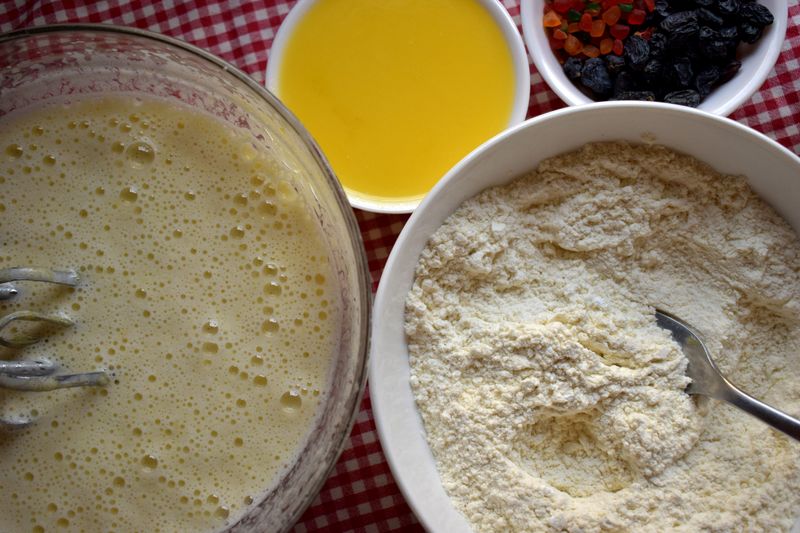
Cakes & Sponges
Folding is the technique that decides how much of your foam survives
Every extra stroke costs volume. Folding well is not about being gentle in a vague way, it is about a specific motion that mixes with the fewest possible movements.
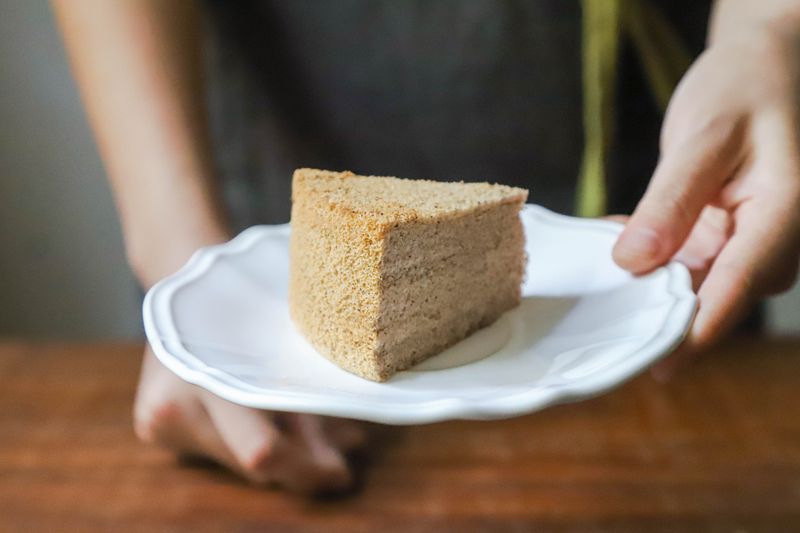
Treat the sections below as a sequence. With folding batter without deflating it, getting the early decisions right makes the later ones much easier.
Before you start
- Slacken the heavy mixture with a third of the foam first.
- Cut down the middle, sweep the bottom, lift and turn the bowl.
- Stop while faint streaks remain rather than mixing to uniformity.
What you are trying to preserve
A whipped foam is a fragile arrangement of gas bubbles held in a thin protein or fat film, and every shear force damages it. Stirring drags the films past each other and merges small bubbles into large ones that then escape.
Folding aims to move the two mixtures through each other with the minimum number of shearing movements. The measure of success is volume: a well folded batter fills the tin higher and bakes taller. Deflation is silent and invisible during mixing, which is why it goes unnoticed until the cake comes out.
Slacken before you fold
Adding a light foam directly to a heavy base means many strokes before they combine, and each stroke costs you bubbles. Beating a third of the foam into the base first sacrifices that portion deliberately to loosen the mixture.
The remaining two thirds then fold in quickly because the base is now closer in density to the foam. This applies to meringue into a chiffon base, whipped cream into a mousse and egg foam into melted chocolate alike. It feels wasteful and it is the single most effective step in the whole technique.
The motion itself
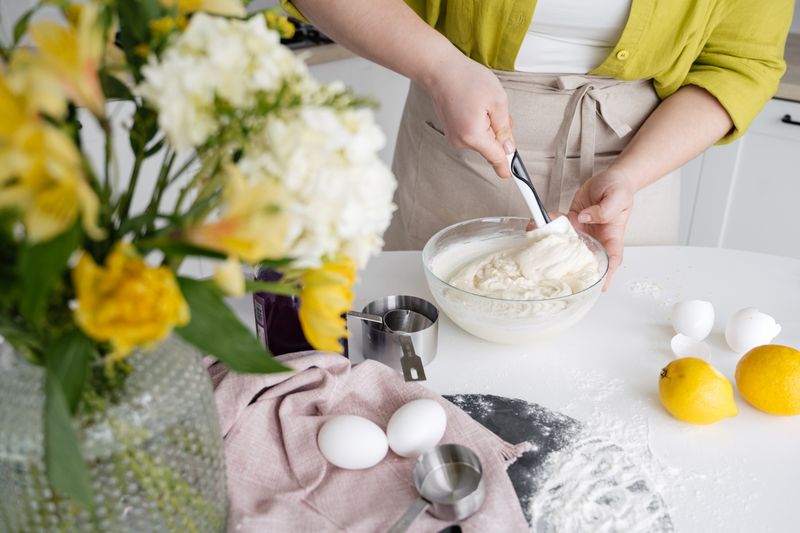
Use the largest flexible spatula you own, since a small one requires three times as many strokes for the same volume. Cut straight down through the centre of the bowl, sweep along the bottom, then lift the mixture up and over.
Turn the bowl a quarter turn with your other hand between strokes so you are always working fresh material. Keep the spatula flat rather than edge-on when lifting, so you carry mixture rather than slicing through it. A confident fold with a large blade does more per stroke and therefore causes less total damage.
Knowing when to stop
Stop when the mixture is nearly uniform but a few faint streaks remain, because those disperse during transfer to the tin. Folding to a perfectly smooth, glossy batter is the standard way home bakers lose a third of their volume.
By the second rise, pouring into the tin and levelling with one pass completes the mixing without further strokes in the bowl. If you can see distinct pockets of unmixed flour or foam, keep going, since those bake as dense patches.
The judgement is a narrow window and it improves quickly with practice.
Adding flour to a foam
Sift flour over the surface in two or three additions rather than tipping it in as a single lump. A lump sinks straight to the bottom and requires many strokes to break up, taking the foam with it.
In the tin, sifting also separates the particles so they hydrate evenly and do not form small dough balls. Some bakers fold with a large balloon whisk rather than a spatula, which disperses flour with less total movement. Whichever tool you use, the addition should take twenty to thirty seconds, not two minutes.
Flour absorbs water differently by brand and by season; hydration is a target, not a rule.
Temperature affects folding
A cold, stiff base such as set melted chocolate or firm butter resists folding and forces extra strokes. Bringing both components to a similar temperature and consistency reduces the work needed dramatically.
Melted chocolate should be around 35 to 40C when folded into a foam, warm enough to move but not hot enough to deflate. Cold cream folds into a warm base badly, seizing the fat and requiring aggressive mixing to combine. Matching consistency before you start is half of folding well.
The takeaway
Slacken first, use a big spatula, turn the bowl, and stop a few strokes before it looks finished.
Patience is an ingredient, and it is the one people leave out.
Questions readers ask
Can I fold with a stand mixer on the lowest speed?
Not effectively for delicate foams. Even the slowest setting shears far more than a hand fold, and the beater works only part of the bowl at a time, so you overmix some regions to combine others.
How much volume am I actually losing if I overfold?
A badly overfolded genoise or mousse can lose a third or more of its volume, which is clearly visible as a shorter, denser cake. Careful folding typically costs ten per cent or less.
Also by Sabyasachi Roy
- Creaming butter and sugar is aeration, and the sugar crystals do the cuttingCakes & Sponges
- Reverse creaming gives a tighter crumb, and here is why it worksCakes & Sponges
- A genoise has no baking powder, so what is lifting itCakes & Sponges
- Baking powder and bicarbonate of soda are not interchangeableCakes & Sponges