Cakes & Sponges
The skewer test misses more than it catches on a rich cake
A clean skewer means no wet batter at that one point. It says nothing about whether the crumb has set, which is a temperature question with a better answer.
This works through testing a cake for doneness in the order the parts actually depend on each other.
The short version
- Most butter cakes are done around 96 to 99C at the centre.
- Melted chocolate and fruit fool a skewer easily.
- Springback and shrinkage from the tin are better visual cues.
What the skewer really tells you
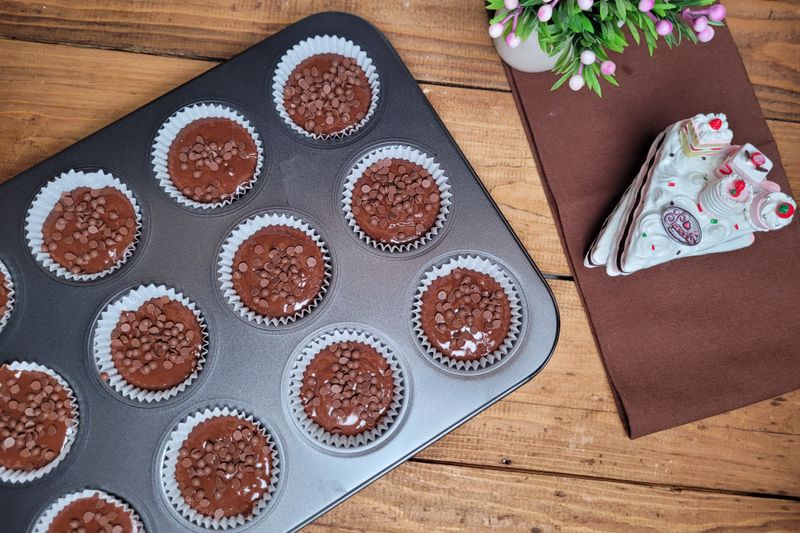
A skewer detects unset batter clinging to it, which means it catches gross underbaking and nothing subtler. It samples one narrow column of a cake that may be baking unevenly across its width. In a cake with melted chocolate, fruit pieces or a molten caramel layer, wet residue is expected and means nothing.
Conversely a skewer can come out clean from a cake that is still two or three degrees short of properly set. It is a coarse instrument being used for a fine judgement.
The temperature answer
Most butter cakes are set when the centre reaches somewhere around 96 to 99C, close to the boiling point of the batter water. Very rich chocolate cakes and brownies are deliberately pulled lower, sometimes near 90C, to keep them fudgy. Cheesecakes are lower again, often 70 to 75C at the centre, since they are custards rather than cakes.
An instant-read probe inserted into the middle gives an unambiguous number in a couple of seconds. These are ranges to calibrate against your own oven and recipes rather than universal constants.
Visual and tactile cues
A finished cake pulls very slightly away from the sides of the tin, leaving a narrow gap you can see. The surface springs back when pressed lightly in the centre rather than holding a dent.
At oven temperature, the sound changes too: an underbaked cake makes a faint bubbling or crackling noise when you listen close. Colour is the least reliable of these, since sugar content and tin material change browning independently of doneness. Two cues agreeing is much stronger evidence than any one of them alone.
Overbaking is the common error
Fear of raw centres pushes most home bakers to leave cakes in five to ten minutes longer than needed. Every extra minute drives off moisture, and a cake loses tenderness far faster than it gains safety. Carryover cooking continues for several minutes after the tin leaves the oven, particularly in a heavy tin.
Pulling at the point where the cake is just set, rather than obviously set, gives a noticeably better crumb.
This is easier to do confidently when you have a number rather than a guess.
Uneven baking
If a skewer is clean at the edge and wet in the middle, the oven is running hot and setting the outside early. Lower the temperature by ten to twenty degrees and extend the time rather than continuing to bake at the same heat.
Once the crumb sets, a cake that is done on one side only points to poor air circulation or a hot spot, which rotating halfway addresses. Deep tins amplify all of these problems, which is why bundt and tube tins exist. Diagnosing unevenness is more useful than adjusting the test you use to detect it.
Domestic ovens routinely run twenty degrees off their dial, so trust a thermometer over the setting.
Different cakes, different rules
Sponges and genoise are done as soon as they spring back, and a minute past that is already too long. Fruit cakes bake for hours at low temperature and are judged by internal temperature and a skewer with no wet batter. Brownies are underbaked on purpose, so a skewer that comes out clean means you have gone too far.
Cheesecakes should still wobble in the centre when removed, because they set during cooling. Applying a single doneness test across all of these is where most of the confusion comes from.
The takeaway
Use the skewer to catch disasters and a probe to catch the actual finish line.
Bake it badly once on purpose. The failure teaches more than the photograph.
Questions readers ask
Is a wooden skewer better than a metal one?
Wood grips wet batter slightly better and is easier to read, while metal cools quickly and can look clean when it is not. Neither difference matters much next to using a thermometer.
Can I open the oven to test halfway through?
Wait until at least two thirds of the stated time has passed. Opening early drops the oven temperature sharply while the structure is still soft, which is a genuine cause of sunken centres.