Cakes & Sponges
A baked cheesecake is a custard in a tin, and it cracks for custard reasons
Treating it as a cake leads to the usual cake instincts, and almost all of them are wrong for a mixture whose structure is set egg protein.

Everything below about baked cheesecake texture comes from what actually happens rather than from what is supposed to.
What holds up in practice
- Egg protein sets the mixture, so gentle even heat matters more than time.
- Beating air into the mixture creates cracks as it cools.
- Overbaking squeezes water out of the set protein.
Why it is not a cake
There is little or no flour doing structural work, and no raising agent creating gas cells to hold a crumb open. What sets the mixture is egg protein coagulating around suspended fat and moisture, which is the definition of a custard. That means the mixture behaves like a delicate baked custard scaled up to the size of a cake tin.
Every instinct that helps a sponge, such as beating well and baking until firm, damages a cheesecake instead. Once you treat it as a custard, the usual instructions about water baths and low heat stop looking fussy.
Why beating causes cracks
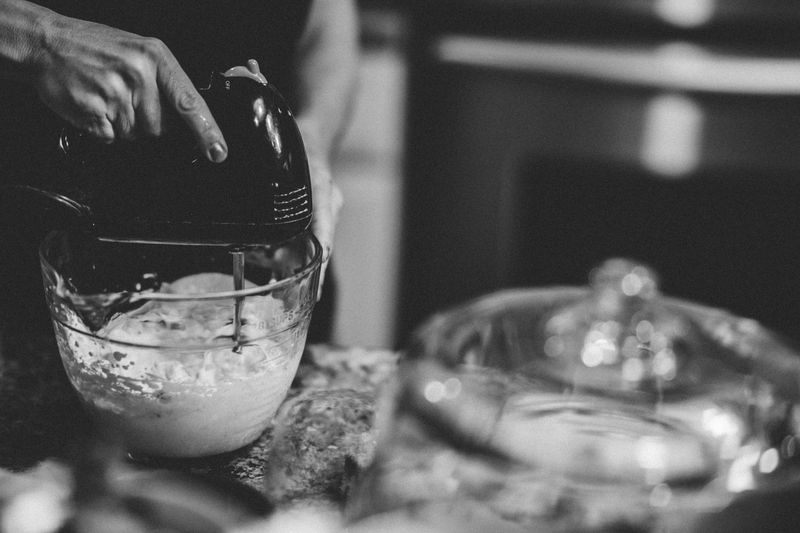
Air beaten into the cheese mixture expands in the oven, lifting the surface and then dropping it as the filling cools. The set protein cannot flow back into shape, so the shrinking surface tears, which is the crack running across the top.
Weighed out, mixing on a low speed, with the cheese already soft, incorporates far less air than beating cold cheese hard. Scraping the bowl thoroughly matters too, since lumps of unmixed cheese have to be beaten out later at exactly the wrong stage. Adding the eggs last and mixing only until they disappear keeps the aeration to a minimum.
Why gentle heat matters
Egg proteins set across a range of temperatures, and pushing past that range makes the network contract and squeeze out water. The edge of a cheesecake reaches setting temperature long before the middle does, so a fierce oven overcooks the outside. A water bath moderates the heat reaching the tin and keeps the oven humid, which slows surface drying and skin formation.
Weighed out, wrapping the tin well or using a larger outer tin keeps water away from the base, which is the usual failure of the method. Baking without a water bath is possible with a low oven and a tray of hot water on a lower shelf.
Knowing when it is done
A finished baked cheesecake is set at the edges and still moves as a soft wobble in the centre when the tin is nudged. Baking until the middle is firm guarantees an overcooked edge and a grainy, slightly weeping texture later. The centre continues to set as the cheesecake cools, which is why it is pulled from the oven before it looks ready.
A probe reading in the centre is the most reliable check, and your recipe should state the figure it was tested at.
Colour is a poor guide, since a pale cheesecake can be badly overbaked and a lightly coloured one perfectly set.
Cooling without shocking it
Rapid cooling contracts the surface faster than the interior, which is the second common cause of a split top. Turning the oven off and leaving the door slightly open lets the temperature fall slowly instead of dropping in one step.
Running a thin knife around the tin edge while the cheesecake is still warm frees it before shrinkage can pull the surface apart. Only after it has reached room temperature should it go into the fridge to finish firming. The full set takes several hours in the cold, and slicing before then gives a soft, smeared cut.
Domestic ovens routinely run twenty degrees off their dial, so trust a thermometer over the setting.
The base and the tin
A biscuit base bakes briefly before filling so that its fat sets, which stops it absorbing moisture from above. Springform tins are standard because a set cheesecake cannot be turned out, and they leak in a water bath without protection. Lining the base with paper makes it possible to slide the finished cheesecake off the metal disc for serving.
Weighed out, a pastry-based cheesecake needs the case blind baked first for the same reason a biscuit base is pre-baked. Cutting with a hot dry blade, wiped between slices, gives clean edges that a cold knife will never produce.
The takeaway
Mix it quietly, bake it gently, pull it while it wobbles, and let the fridge finish the job.
Patience is an ingredient, and it is the one people leave out.
Questions readers ask
Is a cracked cheesecake ruined?
Not at all, since a crack is a cosmetic fault and the texture is usually still good. Topping it with cream, fruit or a soured cream layer hides it completely.
Can I bake it without a water bath?
Yes, with a lower oven temperature and a longer bake, and many recipes are written that way. You lose some protection against overcooked edges, so watch the wobble more carefully.