Cakes & Sponges
A Cupcake Domes Because Its Edges Set First
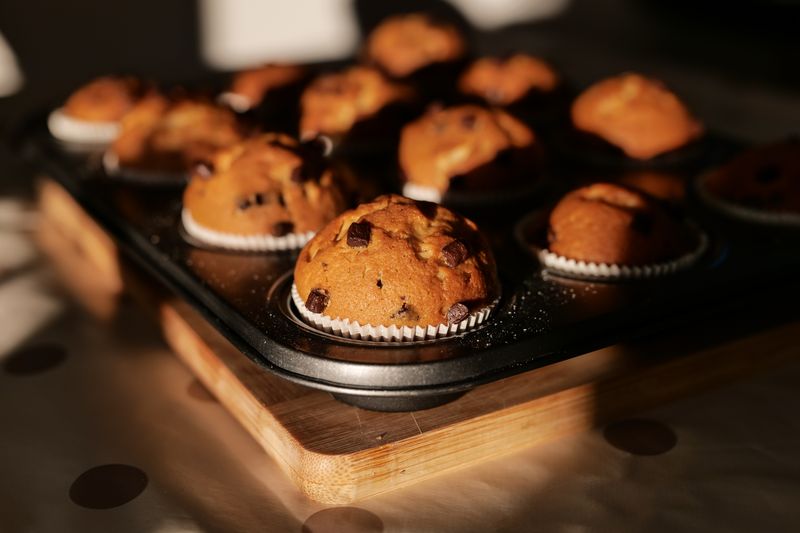
In a small deep case the batter at the perimeter cooks and firms while the centre is still fluid, so remaining expansion has only one direction left to go.

A domed cupcake and a flat sheet cake can come from the same batter. The difference is the geometry of the vessel and the order in which the batter sets.
Heat arrives from the sides
A cupcake case is narrow and surrounded by hot metal on all sides. The batter touching that wall heats far faster than the batter at the centre of the cup.
Within a few minutes the outer ring has passed the temperature at which its starch gelatinises and its egg proteins set. That ring is now a rigid wall.
The centre lags well behind. It is still liquid, still expanding, and still producing and releasing gas from the chemical leavening.
Expansion takes the only route available
Gas and steam in the fluid centre push outward in every direction, but the set ring will not yield. The only unset boundary left is the top surface.
The centre therefore rises, and it keeps rising while the outer ring holds it in place. That is the dome, and it is a direct consequence of uneven setting.
A wide shallow tin has the opposite geometry. Heat reaches most of the batter at similar times, everything sets together, and the surface stays comparatively level.
Oven temperature is the main dial
A hotter oven exaggerates the difference between edge and centre. The ring sets sooner and harder, the centre stays fluid longer, and the dome becomes tall and often cracked.
A cooler oven narrows the gap. The batter sets more evenly, the peak is gentler, and the finished cake is flatter with a finer top surface.
Some bakers use both, starting hot to force a peak and dropping the temperature to finish. Others hold a moderate temperature throughout for a level top to ice.
Fill level changes the outcome too
A case filled near the top has a large fluid mass relative to the set ring, and the excess spills over the rim rather than doming neatly.
A case filled to around two thirds gives the centre room to rise within the case before it clears the rim, which produces a contained dome.
Underfilling flattens the result. There is not enough batter to build pressure, and the cake sets low with a shallow, slightly sunken top.
Batter consistency sets the ceiling
A thick batter resists flowing and supports a tall peak once expansion begins. A thin batter slumps, and much of the rise dissipates sideways.
Strong flour or overmixing produces a batter that holds structure early, which can push the dome into a cracked peak more typical of a loaf cake.
The choice is aesthetic rather than technical. A dome suits a cake eaten as it comes, and a flat top suits anything that has to carry a layer of icing.
Questions readers ask
Is a cracked cheesecake ruined?
Not at all, since a crack is a cosmetic fault and the texture is usually still good. Topping it with cream, fruit or a soured cream layer hides it completely.
Can I bake it without a water bath?
Yes, with a lower oven temperature and a longer bake, and many recipes are written that way. You lose some protection against overcooked edges, so watch the wobble more carefully.