Pastry
Thickening a fruit pie is a starch problem with three different answers
Cornflour, plain flour and tapioca all set the juices, and they set at different temperatures, clear to different degrees and behave differently once cold.

The theory of thickening fruit pie fillings is well covered elsewhere. This is about the version you meet in practice.
What holds up in practice
- Different starches gel at different temperatures and clarities.
- Acidic fruit weakens some starches more than others.
- The filling must actually boil for the starch to set.
Why fruit pies need help at all
Fruit releases a great deal of water as it heats, and that liquid has nowhere to go inside a sealed pie. Without a thickener, the juice pools at the base, soaks the pastry and runs out the moment the pie is cut.
A starch absorbs that liquid, swells and forms a gel that holds the juice in suspension among the fruit. The aim is a filling that holds a cut edge without being stiff, which means using the least starch that will do it. Overthickened fillings taste pasty and dull the fruit flavour, so more is not better here.
How the starches differ
Cornflour sets firmly and turns slightly cloudy, which suits fillings where appearance matters less than a clean cut. Plain flour sets softly, looks opaque and carries a faint floury taste unless the filling is thoroughly cooked. Tapioca and arrowroot set clear and glossy, which flatters bright fruit, though tapioca can leave visible specks if not fine.
Potato starch and rice starch behave differently again, and each has its own texture once cooled. Choosing between them is a matter of appearance, mouthfeel and how the pie will be eaten rather than of quality.
The temperature the filling has to reach
Starch granules only swell and gel above a certain temperature, and each starch has its own range. A pie whose filling never actually bubbles has not activated the starch, however long it spent in the oven.
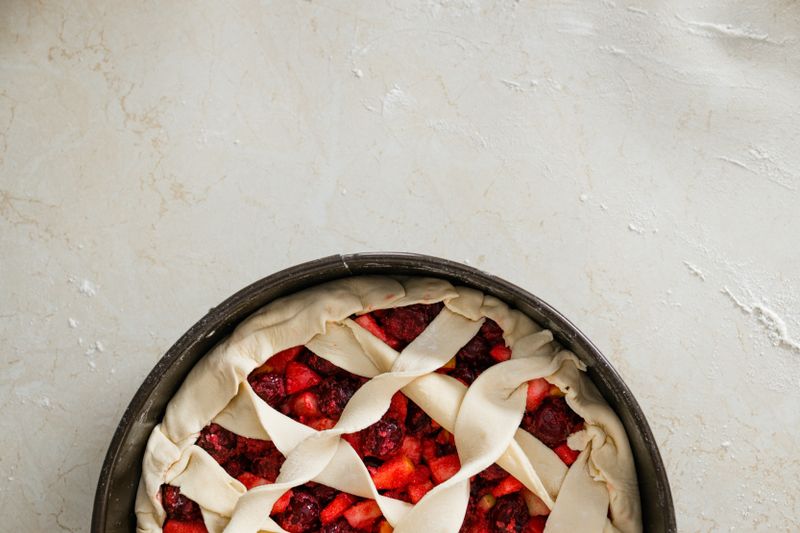
This is why recipes say to bake until the juices bubble thickly at the vents rather than to a fixed time. A cold filling in a cold pastry case takes a long time to reach that point, which is why the oven starts hot. Undercooked starch also tastes raw, which is a separate and equally noticeable fault.
What acid and sugar do to the set
Acidic fruits weaken some starch gels, so the same quantity thickens a rhubarb pie less than an apple one. Cornflour is more affected by acid than tapioca or arrowroot, which is one reason bakers switch for tart fruit. Sugar competes with starch for water and raises the temperature at which the gel forms.
That is why a very sweet filling can look loose at the point when a less sweet one would already be set.
Recipes account for this, which is another reason to be careful about changing the sugar in a pie filling.
Getting it into the filling evenly
Starch added directly to wet fruit clumps immediately, leaving raw lumps and unthickened juice around them. Tossing the starch with the sugar first separates the grains and lets them disperse before they meet liquid.
For very juicy fruit, cooking part of the filling to a thickened base and folding the raw fruit through it works well. Frozen fruit releases far more liquid than fresh, so recipes usually increase the thickener or drain it first. Macerating fruit and using the drained juice to make a thickened syrup gives the most control of all.
Domestic ovens routinely run twenty degrees off their dial, so trust a thermometer over the setting.
Cooling and cutting
Starch gels continue to set as they cool, so a pie cut hot will always look looser than the same pie cut warm. Most fruit pies need to cool substantially before slicing, which is a texture instruction rather than a courtesy.
Some gels weep after refrigeration, releasing liquid that was held when the pie was at room temperature. Flour-thickened fillings tolerate the fridge better than cornflour ones, which can turn spongy when cold. If the pie will be kept, follow national guidance on storing cooked fruit fillings rather than leaving it out.
The takeaway
Pick the starch for the fruit, disperse it in the sugar, and let the filling actually boil before you call it done.
Bake it badly once on purpose. The failure teaches more than the photograph.
Questions readers ask
Can I use a thickener after the pie is baked?
No, because the starch has to be dispersed through the filling and heated with it to gel. A loose pie is better served as it is, with the juices spooned over.
Why did my filling stay runny even though it bubbled?
Either there was too little starch for the amount of juice, or an acidic fruit weakened the gel. Increasing the thickener slightly, or switching to one more tolerant of acid, usually fixes it.
Also by Sabyasachi Roy
- Creaming butter and sugar is aeration, and the sugar crystals do the cuttingCakes & Sponges
- Reverse creaming gives a tighter crumb, and here is why it worksCakes & Sponges
- A genoise has no baking powder, so what is lifting itCakes & Sponges
- Baking powder and bicarbonate of soda are not interchangeableCakes & Sponges