Pastry
Filo gets its layers from stretching, and strudel from the same trick
There is no butter folded into filo. The thinness comes from a very extensible dough pulled by hand until you can read through it.
Everything here earned its place by changing an outcome. Nothing about stretched pastry doughs is included to round the number up.
What matters most
- Strong flour and a long rest make the dough extensible enough to stretch.
- The fat goes between the sheets, not into the dough.
- A little acid and oil in the dough helps it stretch without tearing.
A different route to layers
Laminated pastry folds fat between dough sheets; stretched pastry makes one sheet impossibly thin and then stacks it. The dough is kneaded thoroughly to develop maximum gluten, then rested until that gluten becomes extensible rather than elastic. It is then pulled by hand over a cloth-covered table until it is translucent, often to a metre or more across.
Melted butter or oil is brushed between the stacked sheets, and that fat keeps them from fusing during baking. The eating quality is quite different: brittle and shattering rather than flaky and layered.
Building the right dough
Strong bread flour is used deliberately, because you want as much gluten as possible to hold the sheet together while it thins. A little oil in the dough lubricates the gluten strands so they slide past each other during stretching. Some recipes add a spoonful of vinegar or lemon juice, which slightly weakens the gluten and makes it more extensible.
The dough is kneaded until very smooth and elastic, often eight to ten minutes, then rested for at least an hour. That rest is essential, since an unrested dough is far too springy to pull thin.
The stretching itself
Work on a large cloth dusted lightly with flour, which supports the sheet and lets you move it without tearing. Start by rolling out as far as you can, then work underneath with the backs of your hands, moving around the edge.
Gravity does much of the work as you lift and let the dough hang, so the sheet thins in the middle first. You are aiming for a sheet thin enough to read newsprint through, and holes near the edge are acceptable and trimmed off. Work quickly and keep unused portions covered, since a dried surface tears immediately.
Working with bought filo
Commercial filo is machine-rolled to a consistency no home kitchen matches, and there is no shame in using it. It dries out extremely fast, so keep the stack covered with a barely damp cloth and take one sheet at a time. Brush each sheet with melted butter or oil, using less than feels right, since too much makes the finished pastry greasy.
The dough tells you first: six to eight layers is enough for most applications; twenty makes a thick pad rather than a crisp shell. Frozen filo should be thawed in the fridge overnight, because rapid thawing makes the sheets stick together permanently.
Fillings and moisture
The enemy of stretched pastry is a wet filling, which soaks the sheets and turns crisp into soggy in minutes. A layer of breadcrumbs, ground nuts or semolina between the pastry and the filling absorbs the moisture that escapes.
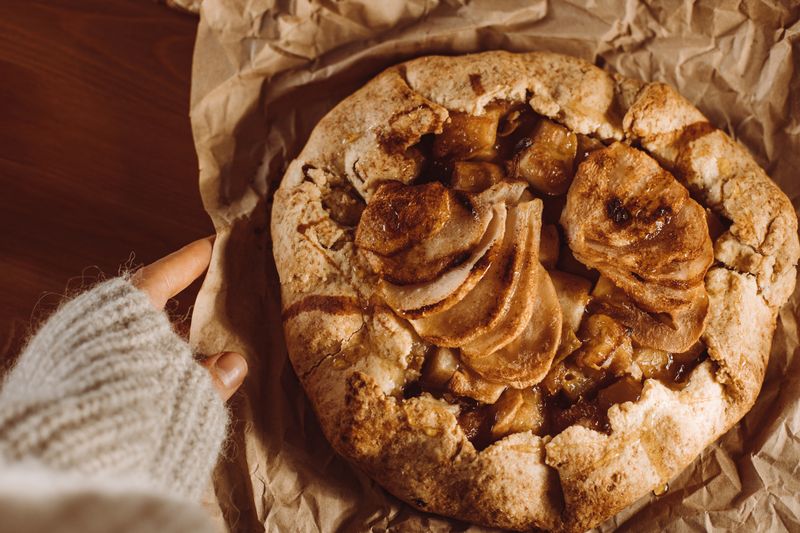
Weighed out, this is exactly what the traditional buttered breadcrumbs in an apple strudel are for. Draining or pre-cooking wet fillings reduces the problem at source and is usually the better fix. Assemble as close to baking as possible, since even a well protected base softens if it sits.
Domestic ovens routinely run twenty degrees off their dial, so trust a thermometer over the setting.
Baking and serving
Bake hot, around 190 to 200C, so the thin sheets dry and crisp before the fat has a chance to soak in. Score the top layers before baking if you will need to cut portions, since baked filo shatters under a knife. The pastry is done when it is deep golden and audibly crisp when tapped.
By the second rise, it softens within a couple of hours as moisture migrates from the filling, so serve on the day. Reheating in a hot oven for five to ten minutes restores much of the crispness the next day.
Everything above, in order of what to do first
- A different route to layers. Laminated pastry folds fat between dough sheets; stretched pastry makes one sheet impossibly thin and then stacks it.
- Building the right dough. Strong bread flour is used deliberately, because you want as much gluten as possible to hold the sheet together while it thins.
- The stretching itself. Work on a large cloth dusted lightly with flour, which supports the sheet and lets you move it without tearing.
- Working with bought filo. Commercial filo is machine-rolled to a consistency no home kitchen matches, and there is no shame in using it.
- Fillings and moisture. The enemy of stretched pastry is a wet filling, which soaks the sheets and turns crisp into soggy in minutes.
- Baking and serving. Bake hot, around 190 to 200C, so the thin sheets dry and crisp before the fat has a chance to soak in.
The takeaway
Develop the gluten hard, rest it long, pull it thin, and keep the filling as dry as you can.
Temperature and time are the same argument held at opposite ends.
Questions readers ask
Can I stretch filo without a large table?
It is difficult, since you need somewhere to lay the sheet flat as it grows. Some bakers stretch in sections and cut, though the sheets end up smaller and less uniform than table-stretched ones.
Is oil or butter better between the layers?
Butter tastes better and browns more; oil gives a slightly crisper, lighter result and does not burn as readily. Many recipes use clarified butter, which takes the flavour without the milk solids that scorch.
Also by Sabyasachi Roy
- Creaming butter and sugar is aeration, and the sugar crystals do the cuttingCakes & Sponges
- Reverse creaming gives a tighter crumb, and here is why it worksCakes & Sponges
- A genoise has no baking powder, so what is lifting itCakes & Sponges
- Baking powder and bicarbonate of soda are not interchangeableCakes & Sponges